Paris, The Cluny, and Napoleon

..The Orangerie is a must visit.

Napoleon’s Death Mask

It’s mid-afternoon. We finally ease into Paris from the périphérique (ease – wrong choice of word).

We feel, if not chipper then somewhat settled, until our GPS instructs us, “to take the eighth exit at the next roundabout.” Eighth! This can only mean the dreaded l’Étoile with the Arc de Triomphe at its centre.

I notice that the GPS has switched to using the same tone as Parisian waiters use when you’ve asked for something unusual, like a seat out of the draft.

l’Étoile! Twelve streets worth of traffic circling the Arc like a great school of rather nasty sharks, each with a different plan. In the midst of the mayhem, dozens of selfie-taking tourists sprint back and forth like unwary bait fish.

When we find street work blocking every access to our destination like Byzantine walls, we almost don’t care. Magically, we seem to have slipped into a Kamikaze-like fatalism. Perfect for navigating Paris.

No point yet in discussing the hotel and underground parking garage here. No point in casting a leaden pall over this whole exposition. But, then, miraculously, we’re 4 levels underground in our stall, and I can turn off the ignition. Neither of us are sure how we got here.

Paris! The Tuileries

A quick feed, a wash and brush-up, and we’re good to go. Art, food, culture, history – Paris has it all. Great perspectives too.

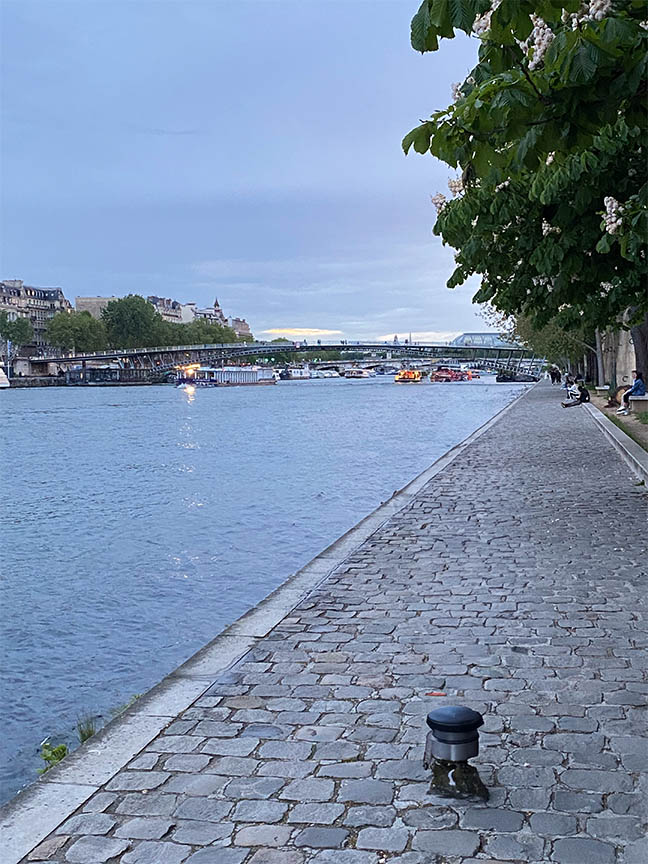
An evening view of the Eiffel tower from the Trocadero – wow! And strolling the banks of the Seine on a warm, spring evening is pretty well as romantic as it gets.

I don’t expect to see many birds (other than Wood Pigeons) in Paris. One has to know a big city very well to find unusual birds. I include Wood Pigeons in this post – this is called Bird Noetz, after all. I spot a few Blackbirds in the Tuileries too.
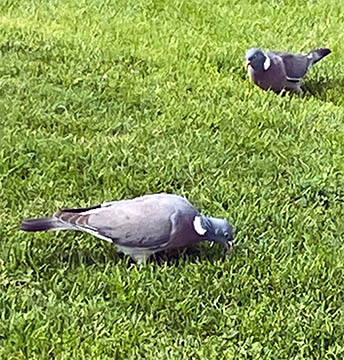
Wood Pigeons in the Tuileries

Wood Pigeon watching is free in Paris, but almost everything else costs from a lot to plenty. Department stores like Printemps now seem outrageously expensive. Galeries Lafayette, forget about it.

Specialty soap shops such as the one V. discovered, should have armed guards around the merchandise. You can either buy a bar of soap, or dinner – your choice. But,ah, it’s Paris, unlike any other city in the galaxy.
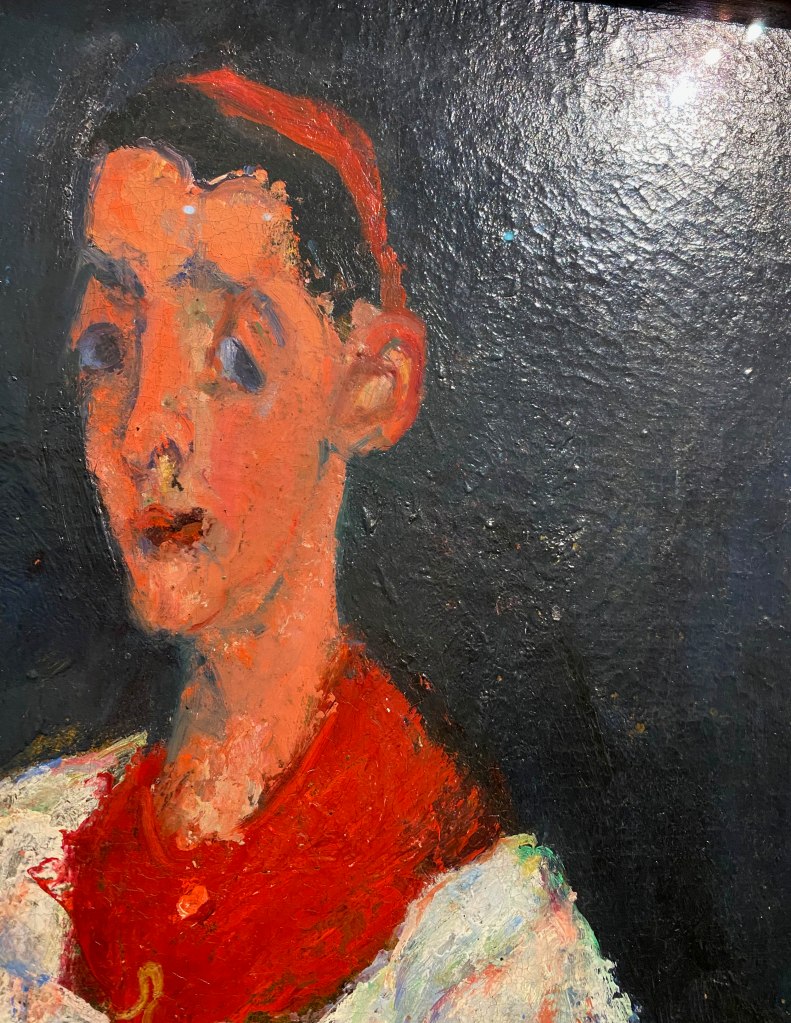
Soutine, I believe

The Orangerie is among the world’s great galleries. It’s filled with modern works, as the brochure says, from “Renoir to Matisse, from Cézanne to Picasso, from Douanier Rousseau to Modigliani and Soutine.” Even so, it’s still manageable. Lots of selfies going on here too. À chacun son goût, I guess.

Monet’s famous Water Lilies is the star attraction, and these giant panels are stupendous works. Luminous. Colour choices and juxtaposition, sensational.
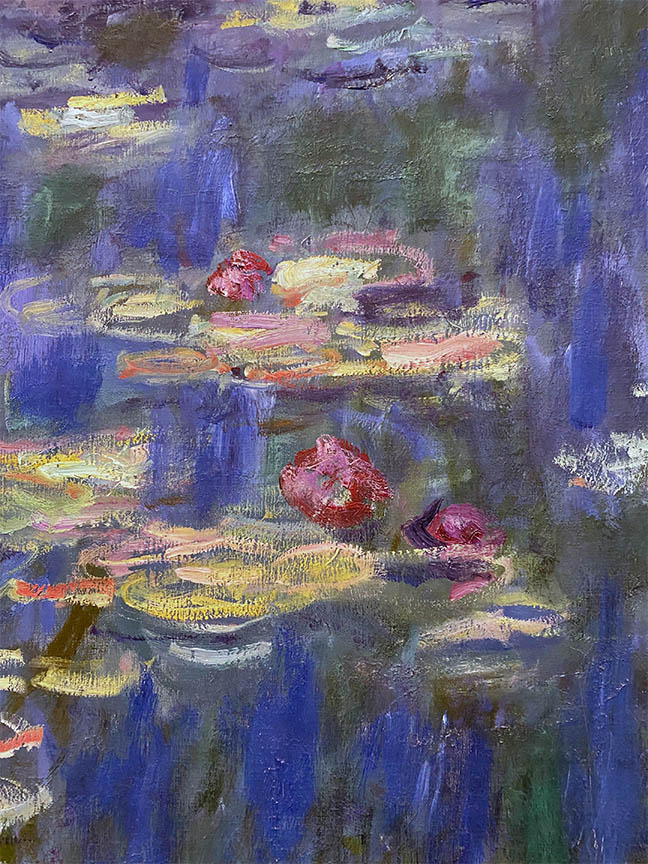
Monet – Waterlilies (detail)

Napoleon. Not everyone is a fan of the Ist Emperor, but he certainly made his mark. Spend any time at all dealing with the niceties of French bureaucracy, and you’ll see what I mean.

I once had to fill out quite a bit of paperwork to get my wallet back after I’d left said wallet on a national park ticket counter for thirty seconds. Even with my picture ID inside, it still took two hours to get the thing back. Being in France, I had the proper documents in order, and stamped, naturally.

Of course, there’s much more to Napoleon and his legacy than unnecessarily inconveniencing me. The Russians and Austrians were very badly inconvenienced by him at the Battle of Austerlitz, for example. The beautiful Alexandre III bridge is just the allies getting back at the Ist emperor.

A fascinating and complex individual, Bonaparte, and the subject of countless studies and books. The city of Paris is a more monument to Baron Haussmann of course, but there is a lot here that is Napoleon too. His tomb in the Invalides is a must for students of history.

Napoleon’s bicorne from Waterloo – Don’t you hate it when your hat gets wet!

Bonaparte’s Sarcophagus

The Cluny

The impressive Cluny museum in the Latin Quarter preserves a bit of medieval Paris. More than a bit, actually. One of the best collections of western European medieval art anywhere is preserved here.

The frigidarium of an Roman bath complex forms the ‘bones’ of the museum. Incidentally, Clunaic style influenced the art and architecture of much of western Europe during this period.

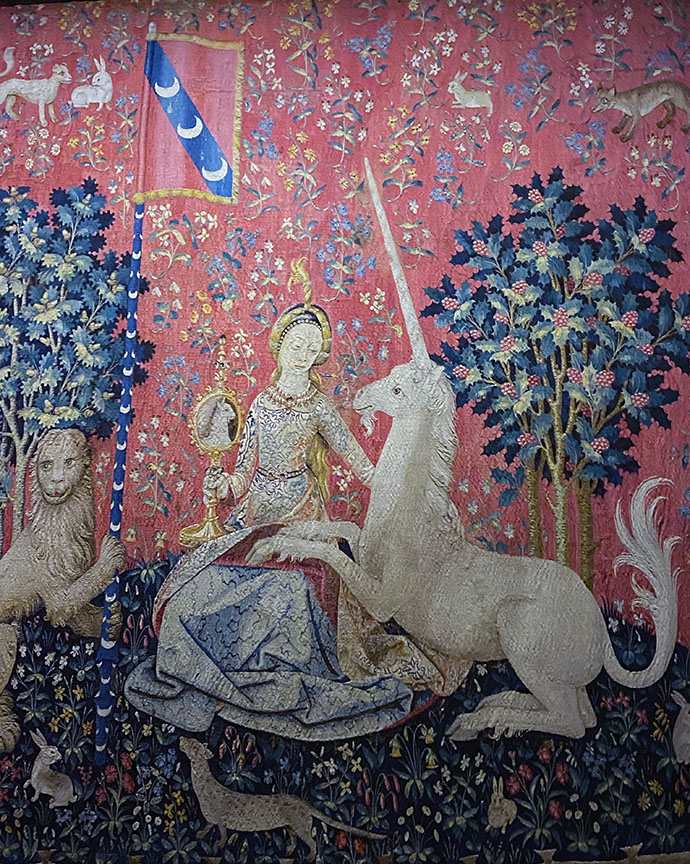
The museum famously houses the Lady and the Unicorn tapestries. A late medieval work loaded with symbolism, this is a testament to the skill of the weavers of Flanders. Perhaps Monet thought about the tapestries when he painted Water Lilies. Ukyio-e prints, sure, but maybe these too.

The unicorn symbolizes purity and religious grace. Only virgins can capture unicorns, by the way. Just so you know.

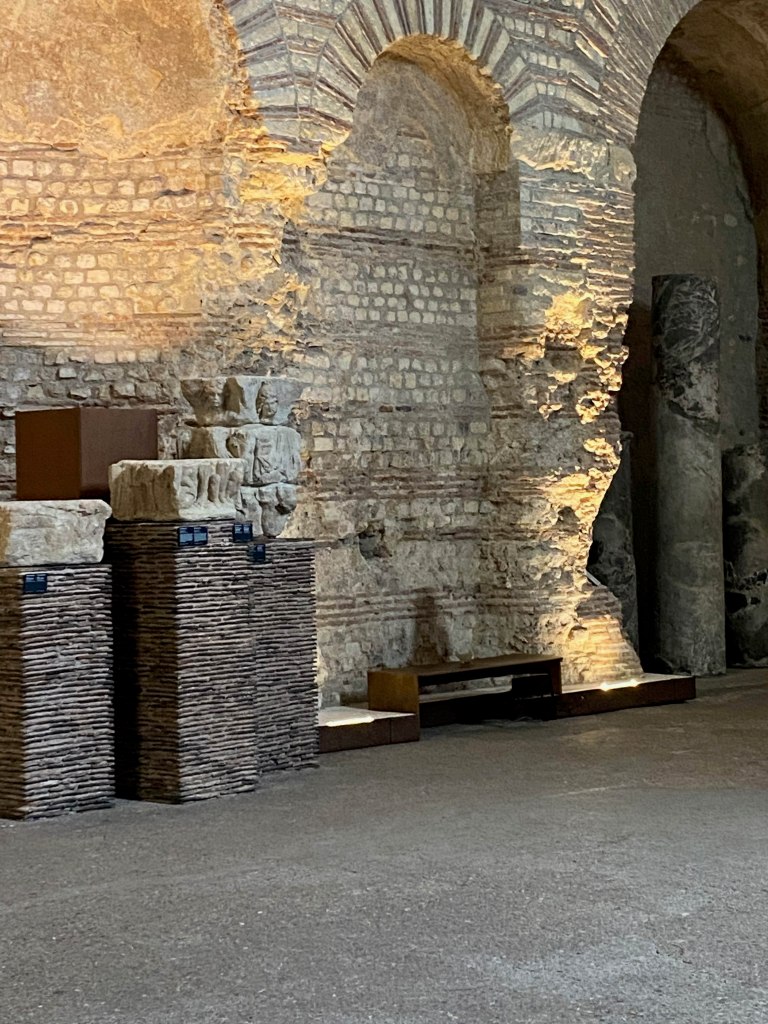
Cluny courtyard, Roman Baths, and the Demoiselle et le Licorne

It’s Paris and, of course, the food is great. The food court at the Bon Marche always lures us in. This time, no exception. Often, we wonder if the visit is an excuse to roam from eatery to eatery.

I hear many that French people lament the fading of some customs such as the 3-hour lunch. Probably it’s more the non-locals, like us, that bolt and run, Parisians seem as meal conscious as ever.

We try to let the French public choose where we eat. If a place is bustling it’s likely good; if it’s as quiet as “an undiscovered tomb” (as Henry Higgins says), it’s almost certainly not.

After a good meal, and a glass or two of decent wine, there’s the evening stroll along the Seine. Nice way to end our visit. Tomorrow, Sancerre.
Red Kytes and Polychrome Bulls: Visiting Lascaux

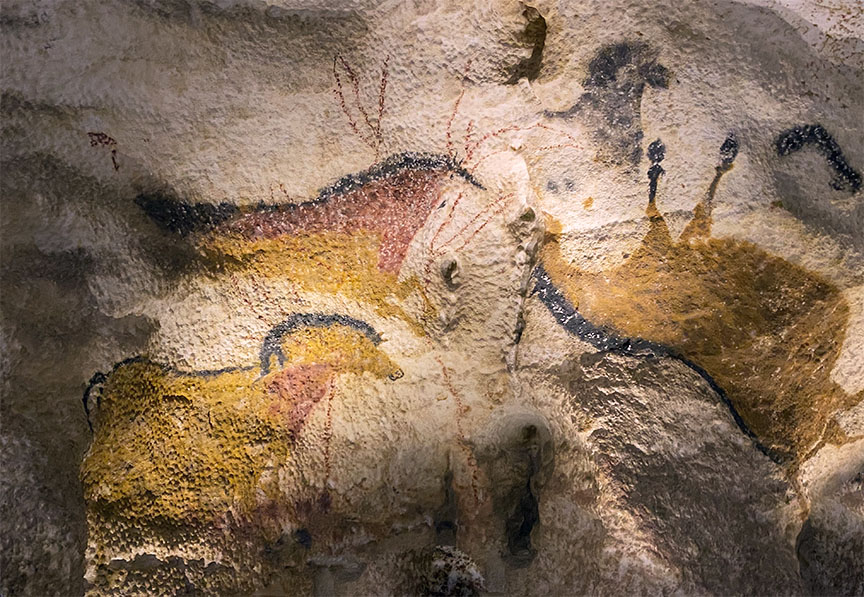
Ice Age Horses

A bit longer in Perigueux, with a chance to visit its museums, would have been nice. However, we had tickets to see the famous paleolithic art of Lascaux. Plus we had to be in Paris that evening. So, after a quick breakfast, we packed up and hit the road.

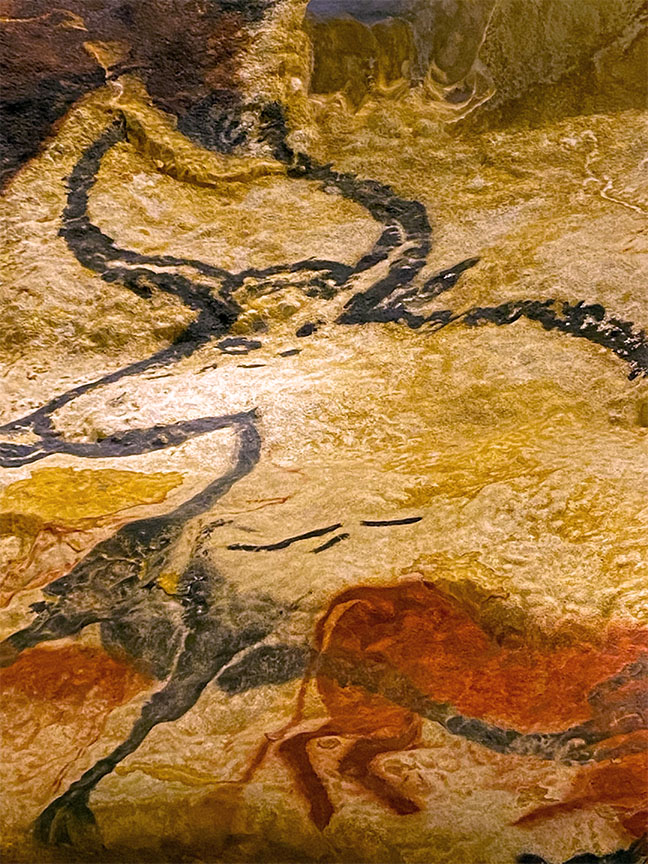
Auroch

I had longed to see Lascaux when I was a young archaeology student. Impossible then when gourmet macaroni and cheese was high living. Now, I’ve long forgotten the professors who taught me, and much of what I learned about the palaeolithic – it’s been a while – but Lascaux stuck with me.

Someone, or a bunch of people, have called Lascaux the “Sistine Chapel of Paleolithic Art”. I’m not sure why it isn’t the other way round, chronologically-speaking, but anyway. Certainly, the paintings are remarkable. And there are others. The Karst bluffs along the Vézère are famous for their caverns. Many were occupied on and off over the last 40 000 years or so of the last ice age. Amazing place!

Red Kytes

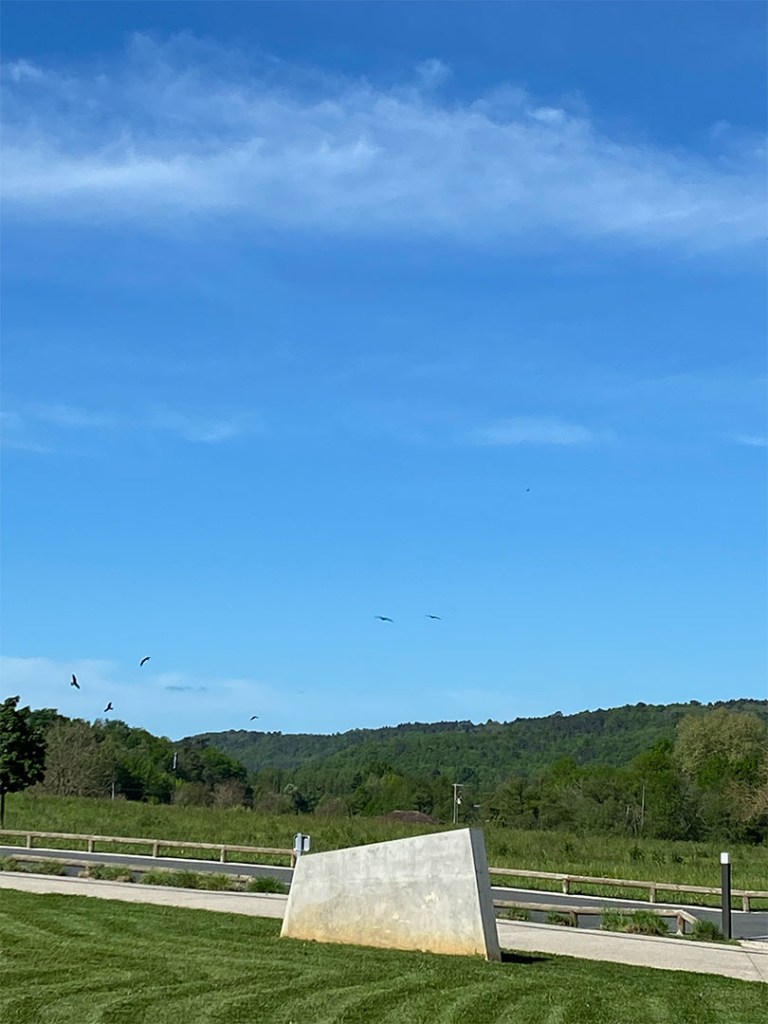
We arrived on a perfect day, sunny and mild, with a slight breeze. A few dozen migrating Red Kytes, and what looked like a Booted Eagle or two, kettled over low, heavily-treed hills, drifting west on shifting thermals. My real camera having just decided to give up the ghost a day or two back, I had to depend on my phone – not at all ideal for bird photography.

The Limestone Hills of the Vézère Valley

A warm day like this would have been rare when the cave walls were painted. It was the last ice age, after all, when giant deer, aurochs, wild horses, rhinos, and mammoths roamed the neighbourhood. The portraits of such beasts adorn the cavern walls. Were they created for magical purposes, or otherwise? Nobody can say. Europe was quite Arctic-like then. Inside a cavern probably wasn’t a bad place to be. So, there’s that.

With the cavern-riddled hills as a backdrop, the buildings containing the exhibits overlook the pleasant village of Montignac.We couldn’t see the actual caverns of course. These were closed to the CO2-breathing public many years ago. Instead we see exact re-creations of important galleries. And they certainly seem perfect, even down to the smell of cold stone. Or perhaps I was imagining that. A subconscious childhood memory maybe from when I explored the limestone caves in the cliffs surrounding the town where I lived. I once scratched my name on the cold stone. Maybe I painted a picture of a deer too, maybe.

These paintings are terrific – powerful, realistic representations of ice-age beasts. They are dated to the Solutrean, or Magdelanian. The aesthetic seems consistent with that of the beautiful, cunningly-flaked, leaf-shaped projectile points from the period. Beautiful things they are too!

My student attempt to flintknap a Solutrean Point. Not very good,I suppose, but, the right shape. Trying to replicate artifacts teaches archaeology students something about the methods and skills of the tool-makers.

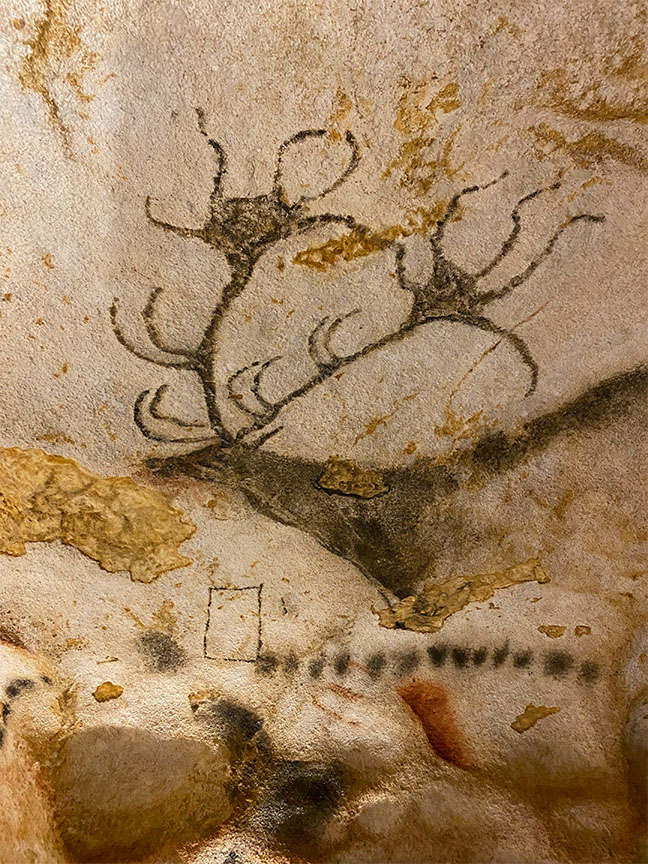
Ice Age Beasts and Mysterious Markings. The artist (s) obviously ‘played’ with images, as with the antlers on this deer.

As to the significance and purpose of cave art. Who knows? Seventeen thousand years is a long time, and, as David Lowenthal once pointed out, “The Past is a foreign country; they do things differently there.”

While the paintings are indeed spectacular, the object that fascinated me most was a small, red-stone lamp. Easy enough to miss, but charming too.

I like to think that the person who made and used this lamp made some of the pictures too. Thinking about that actually gave me a bit of a shiver. I was seeing, in that humble artifact, the hand and mind of a long-dead, working artist, and, in a way, communicating with them.

Lamp

Indeed, it is the small accidents of survival that can, in a flash, bridge the millennia between oneself and a maker – the slip of the brush, the thumbprint in the clay, the misplaced notch on the spear shaft. They blur time and cause it to slide a bit. Suddenly, an age or two seems like nothing at all. The small, casually-dropped things, the trivial artifacts, often have more emotional power than the famous, colossal, historic monuments. Not that I won’t go look at those too!

Périgueux: The Dordogne

Isle River Bank – Local Inhabitant

Our next stop should have been Paris, but Paris on May Day seemed an even worse option than Bordeaux. Instead we leapt (figuratively speaking) at the chance to spend a couple of nights in the old pilgrim town of Périgueux in the Dordogne – famous for its medieval streets and massive cathedral. Bordeaux was great, but birding there, well…

Saint Front Cathedral in Périgueux

Périgueux is on the banks of the River Isle in the heart of the Périgord, home of foie gras, black truffles, and duck confit. A number of authors have set books here and in the region, including Michael Crichton. Martin Walker too, with his enjoyable Bruno mysteries.

The massive Romanesque Saint Front cathedral dominates the medieval core of the town, which has a history going back to pre-Roman Gaul and beyond. The museum here is reportedly quite good.

The prehistoric cave paintings at Lascaux, also, are not far away. They date back 17,000 years or so. More about those in my next post.

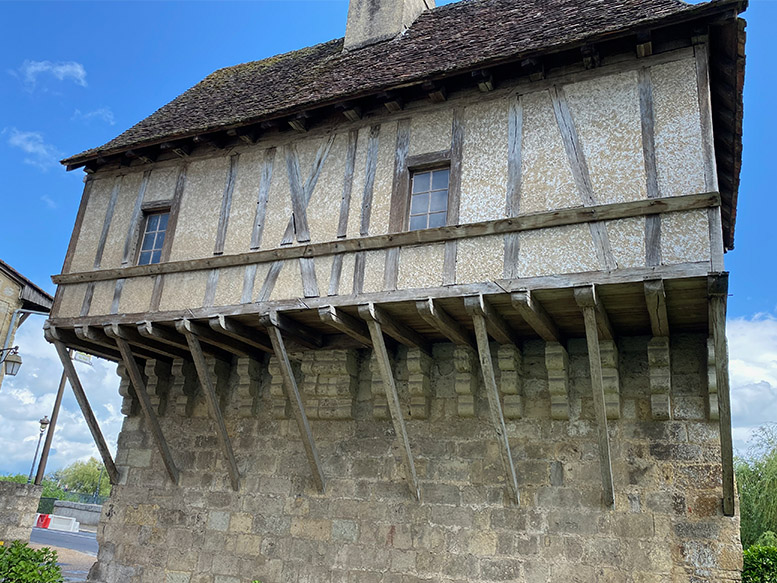
Périgueux Architecture

Unfortunately, most restaurants and shops in Périgueux were closed both days – this being Sunday, followed by May Day – as were the Gallo-Roman and Military Museums. Drat!

Still, the cool afternoon was pleasant; the streets narrow and interesting. We had to limit ourselves to window shopping. Probably just as well. They do seem to sell some nice stuff.

We stopped for charcuterie at an outdoor cafe, one of the few places open, but whose name neither of us can remember. The glass of champagne here surprisingly inexpensive, nicely complimenting the generous platter of cured meats and the cheeses.

With not much else to do but enjoy the slightly breezy afternoon, we lingered with glasses of Bergerac, the local wine. Bergerac is under an hour away from here.
The red seemed rather like a Bordeaux, but softer – more Merlot in this blend, I think; the white crisp and aromatic Sauvignon Blanc, exactly what V. likes best. No sign here of Cyrano however.

Sunday in Périgueux

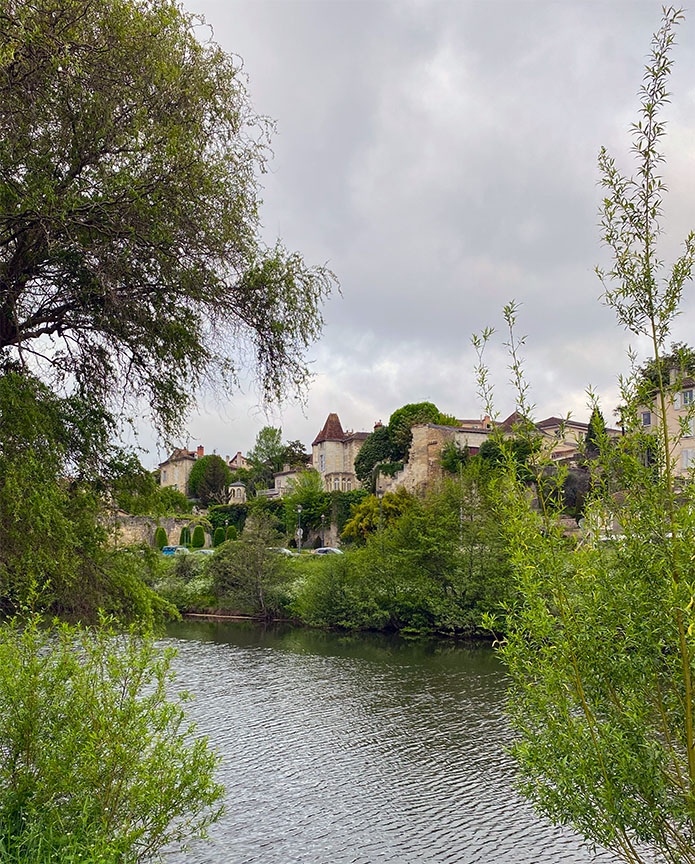
The Isle is a pleasant, unhurried river with treed banks down to the water, and a paved walkway. Aside from a couple of early morning strollers, and a dog walker or two, there was no traffic to disturb the many small birds singing and calling from the thickets.

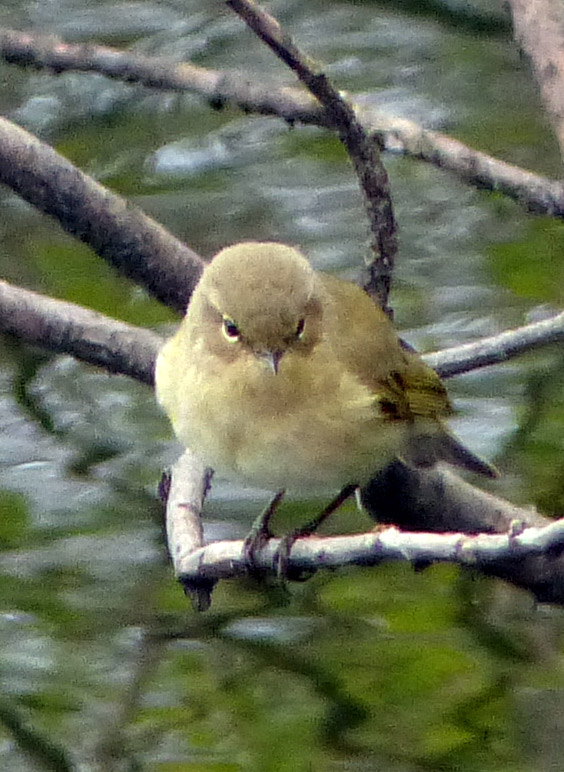
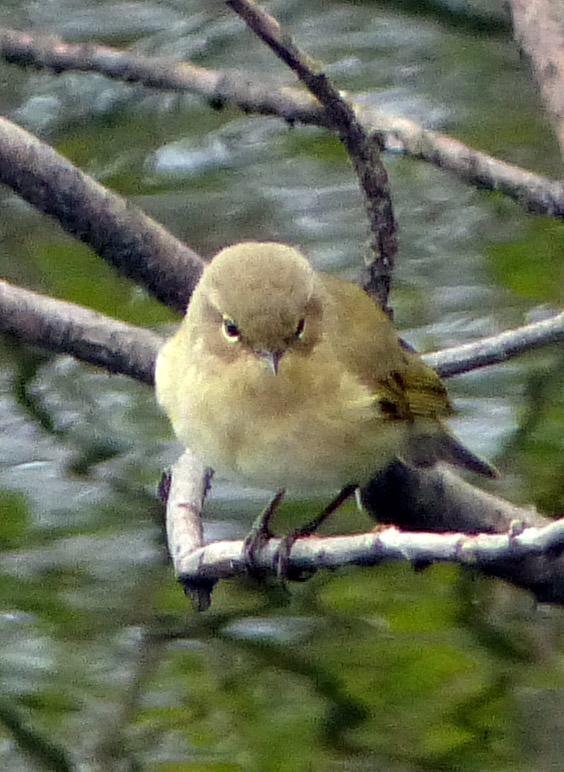
My Merlin app confirmed nineteen species, from European Pied Flycatcher to Common Chiffchaff.

Hearing birds was easy, spotting them was almost impossible. At one point, I half-slid down on bank trying to get a better look at the Pied Flycatchers, and almost ended up in the drink. That would have been embarrassing. Would I have remembered how to say, “throw me a line!” in French? I doubt it.
The Flycatchers are pretty little black and white birds, and new to me. Very active, and, in the thick foliage, almost impossible to photograph.

The River Isle in Early May

So…I’m going to say, Chiffchaff.

The valley of the river also has its share of parks, walks, and historic sites, including chateaux. Driving through the area was quite pleasant. Lots of limestone.

I have mixed feelings about chateaux, although they’re pretty impressive. But who got exploited here when the aristos built and managed the place, I wonder? That’s the Liverpool in me talking. Sorry.

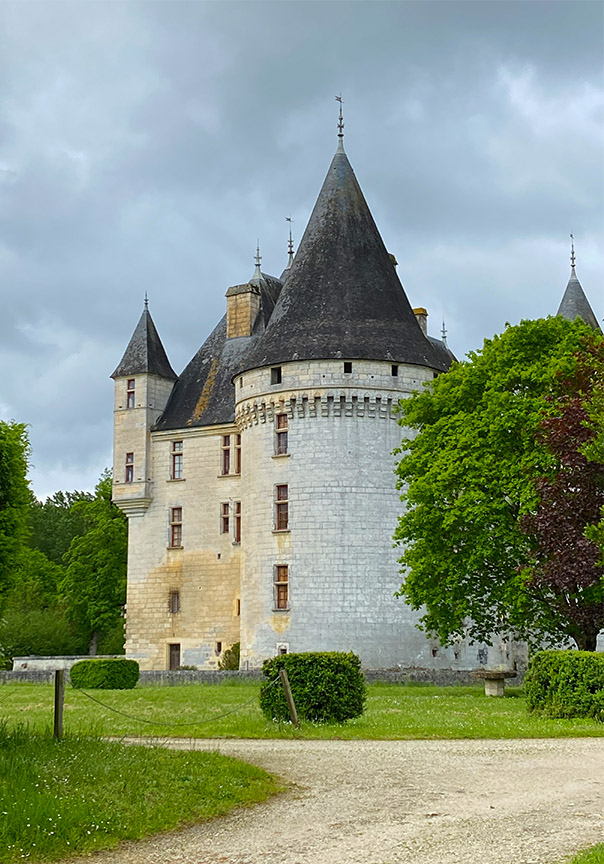
Chateau Puyguilheme

With a bit of imagination, one can people the turrets and galleries with imaginary musketeers, courtly ladies, and Cardinal Richelieu. The period is right, I think, for this place – 16th century. Still, it’s lovely and quiet today. Renaissance architecture, it has been renovated by the French state. Closed when we visited.

History, Birds, and Wine: Bordeaux and Saint-Émilion

Eurasian Blackbird

It seems like a long time since I posted, but I’m back. Lots to report too.

Late April, 2023

After a pleasant and interesting few days in Barcelona, we caught the train to Bordeaux. The train skirts the Pyrenees, and follows the Mediterranean coast to Narbonne, Roman Narbo, a town I wish we’d had more time to explore. Then the line cuts sharply left- the route forms a right angle.

The coastal marshes speeding past the windows of the train are famous birding locations. Even rocketing along on the TGV, one can pick out quite a few species. There’s a trick to it, mostly looking well ahead and focusing on a group of birds until they pass.

No birder can pass these brackish flats without at least trying, despite the resulting headache. So, the list: Common Shelduck, Greater Flamingo, Slender-billed Gull, Yellow-legged Gull, Grey Heron, Little Egret, Eurasian Marsh Harrier, Eurasian Kestrel, Eurasian Magpie, Mute Swan, Pied Avocet, Eurasian Oystercatcher. These at the Salines de la Palme and the Grau de la Franqui. No photos, of course. You’ll have to take my word for it, but I won’t blame you if you don’t.

A quick stop in Narbonne to change trains, and then we’re off to Bordeaux on the fast train. I expected to see lots of white Storks en route, but there was nary a one.

Our apartment in Bordeaux was a bit of a surprise both in terms of location and size, but at least it was close to the laundromat so we could wash our clothes. We rubbed shoulders with the undergrads who, by the way, were very helpful.

The next day we picked up our rental car on the edge of town. Finding our way back to our lodgings from there, and solving the mystery of the underground parking garage,made for an interesting morning.

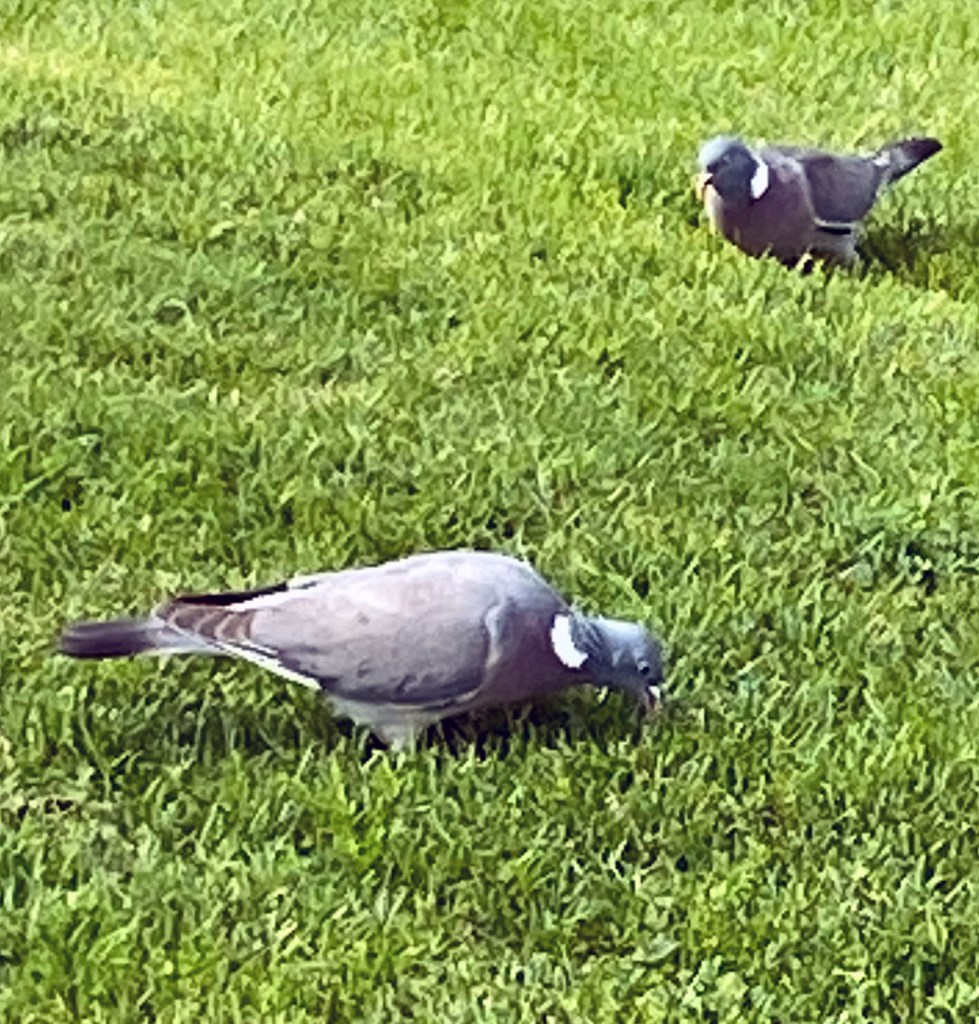
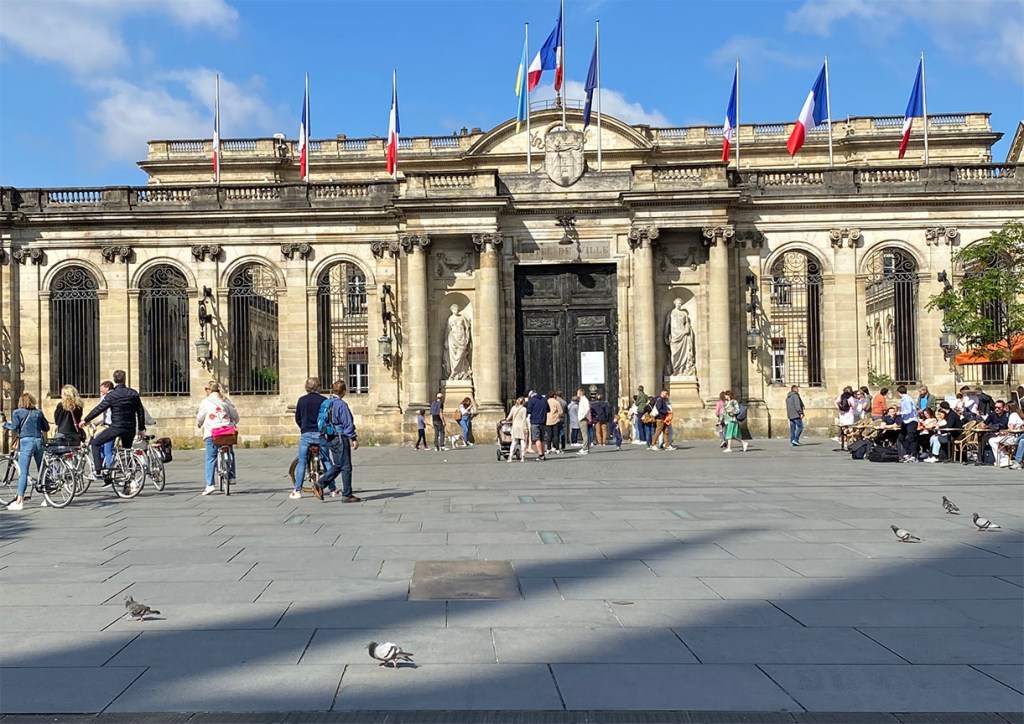
Our stay in Bordeaux had to be short, just three days. We ate some great food, drank some of the region’s luscious wine, had a thoughtful gaze at the charred doors of the city hall (Palais Rohan), suddenly famous after the riots over government policies earlier in the year. We visited the underwhelming wine museum, and strolled the famous river front too. Other than Rock Doves and Mallards, we saw precious few birds in Bordeaux — Common Swift, Eurasian Blackbirds, a Serin, Common Wood Pigeon. Not enough time to look, really.

Wood Pigeons

The Palais Rohan

On Sunday morning we freed the rental from the bowels of the labyrinthine parking garage, popping out into the narrow streets of the university district like Jonah from the whale, and then headed out. We planned to arrive in Périgueux on the River Isle in late afternoon. Saint-Émilion, that famous wine town, was, more on less, on the way. To go to the Bordeaux region and not visit this famous village seemed unthinkable.

The charred doors of the Palais Rohan (city hall)in Bordeaux, set on fire during protests against government policies.

The gray morning turned bright and warm (briefly) as we left the busier roads for narrower ones that followed the contours of lovely rolling hills carpeted with vineyards.

Our route took us past chateaux with very famous names we recognized at once, a somewhat surreal experience. Not the least of these was Château Pétrus, identified by modest signs marking the rows of vines that produce this extremely expensive Pomerol wine. No big showrooms and gift shops here. No need when a bottle of 2022 will cost you 6000 dollars U.S., if you can find one.

We didn’t attempt to visit the Chateau; I’ve been sneered at by enough Parisian waiters and other guardians of French culture to be able to predict the kind of look I’d get, even if someone deigned to open the door to our knock. Kind of like the look the Maître d’ of Club 21 in New York once gave my flip-flops.

Out of the car, the place was magical, the air still and fragrant with the scents of growing plants, of budding flowers, and of pale, buff-coloured loam; the fluting songs of Blackbirds and Wood Thrushes floated up from here and there along the rows. A Yellowhammer zoomed past, a mustard-coloured flash diving toward some choice spot among those old vines. Overhead, a Common Buzzard circled. If terroir makes a wine, as it must in large part, then we are experiencing it, at least in the only ways we could afford. Magical!

Château Pétrus: In the movie, Sideways, Miles refuses to drink any “stinking Merlot”? Too bad. Pétrus grows only Merlot.

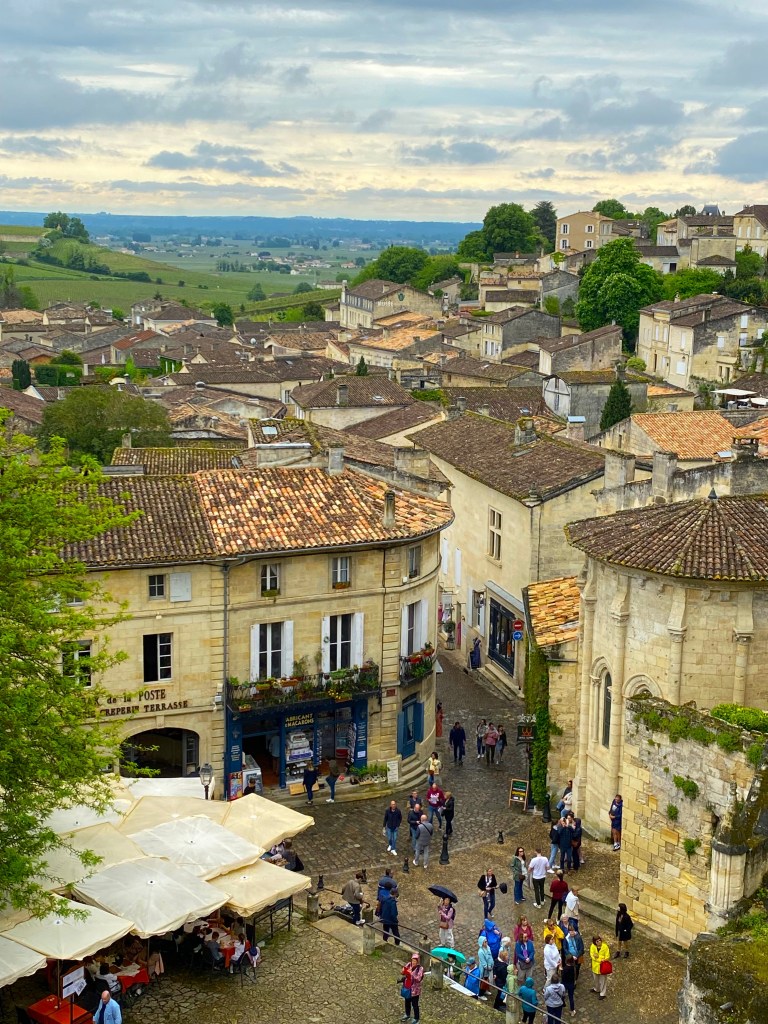
Saint-Émilion, on a cool, slightly rainy April day. Lots of wine ‘caves’ to drop into for a tasting.

Saint-Émilion was busy and parking was a challenge. A bright day, as I say, and generally true, except for an the occasional shower. A bit cool when the clouds hid the sun – I had to buy a warm vest.

I can’t say that this famous village is unspoiled, but it tries its best. Saint-Émilion occupies a hilltop around which vineyards radiate like spokes on a wheel.

Like all tourist towns, this one has lots of places where one can buy things, but precious few reasonably priced eateries, especially perhaps, on a Sunday in April. Saint-Émilion was, and is I believe, also a stop on the old pilgrim route to Santiago de Compostela.

The medieval church is a must-see. It is dedicated to the saint (8th century, I think). It, and many other buildings, typify the solid stone architecture that often marks a successful, economically-viable French village with a long history. It doesn’t hurt either that this one is at the heart of one of the greatest vine-growing regions in the world.

Augarten, Vienna

Augartenoc1818

Augarten Park, Vienna

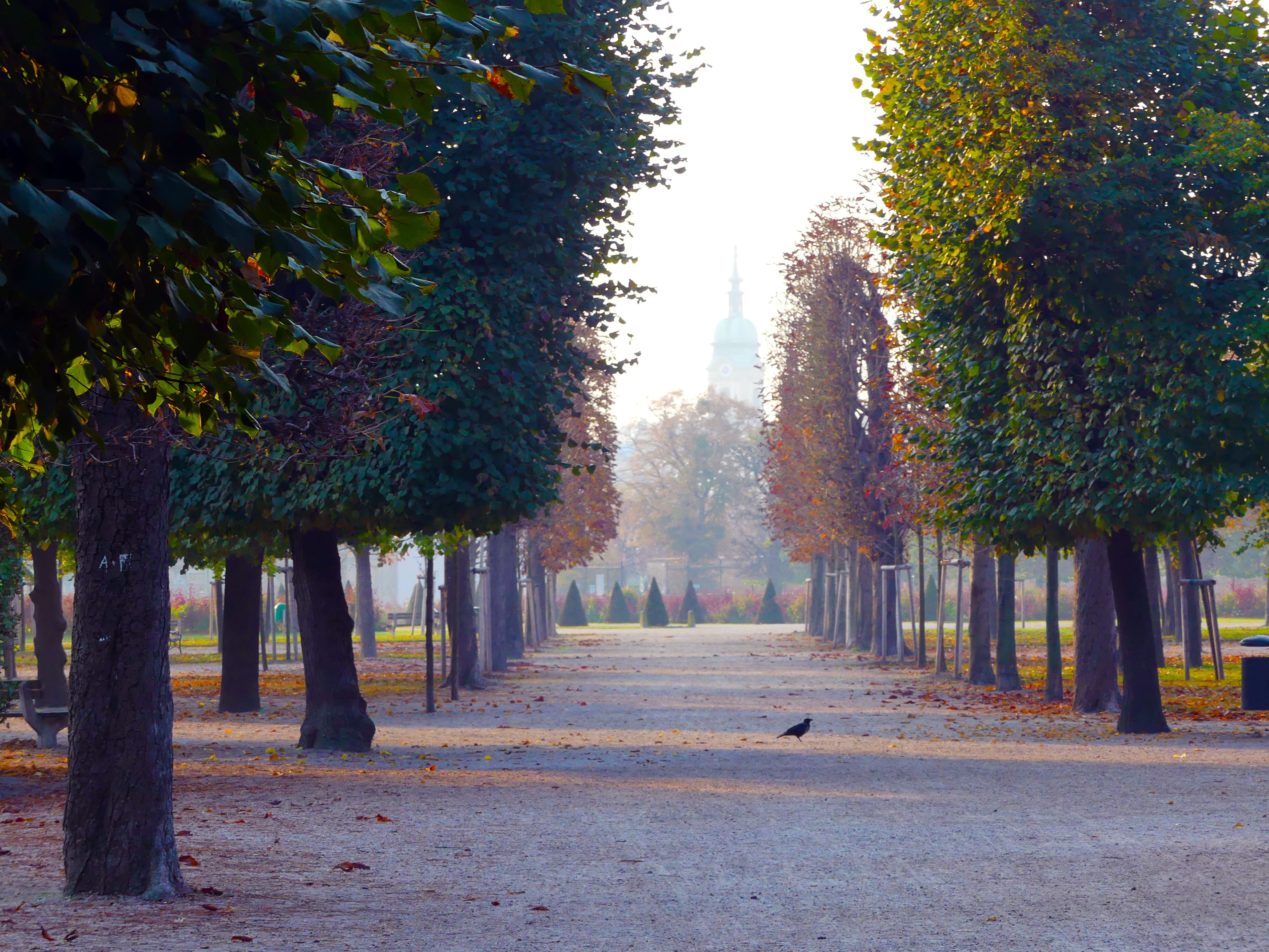
I’m up early hoping to pick up a few Vienna birds before Augarten Park wakes up.  The preschool isn’t yet open and early morning joggers are few. Likewise, the porcelain manufactory in Augarten Palace (established in the 18th century) is still closed. So is its pleasant cafe, which is too bad. You can buy a teacup in the shop for 500 euro (sans tea) here if that’s your thing.

AugartenFlakTwrOc218

Flak Tower

Flaktwroc1818

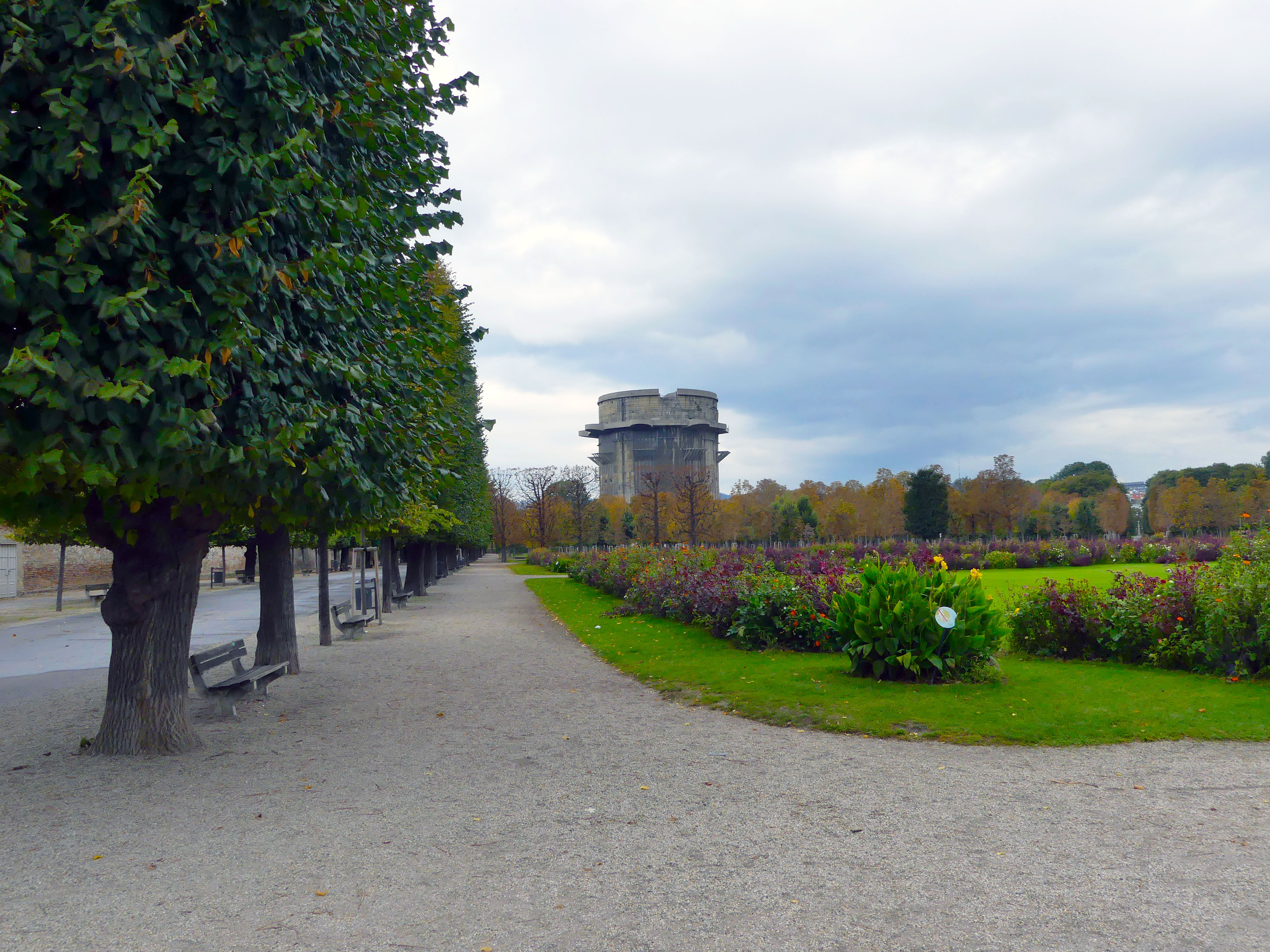
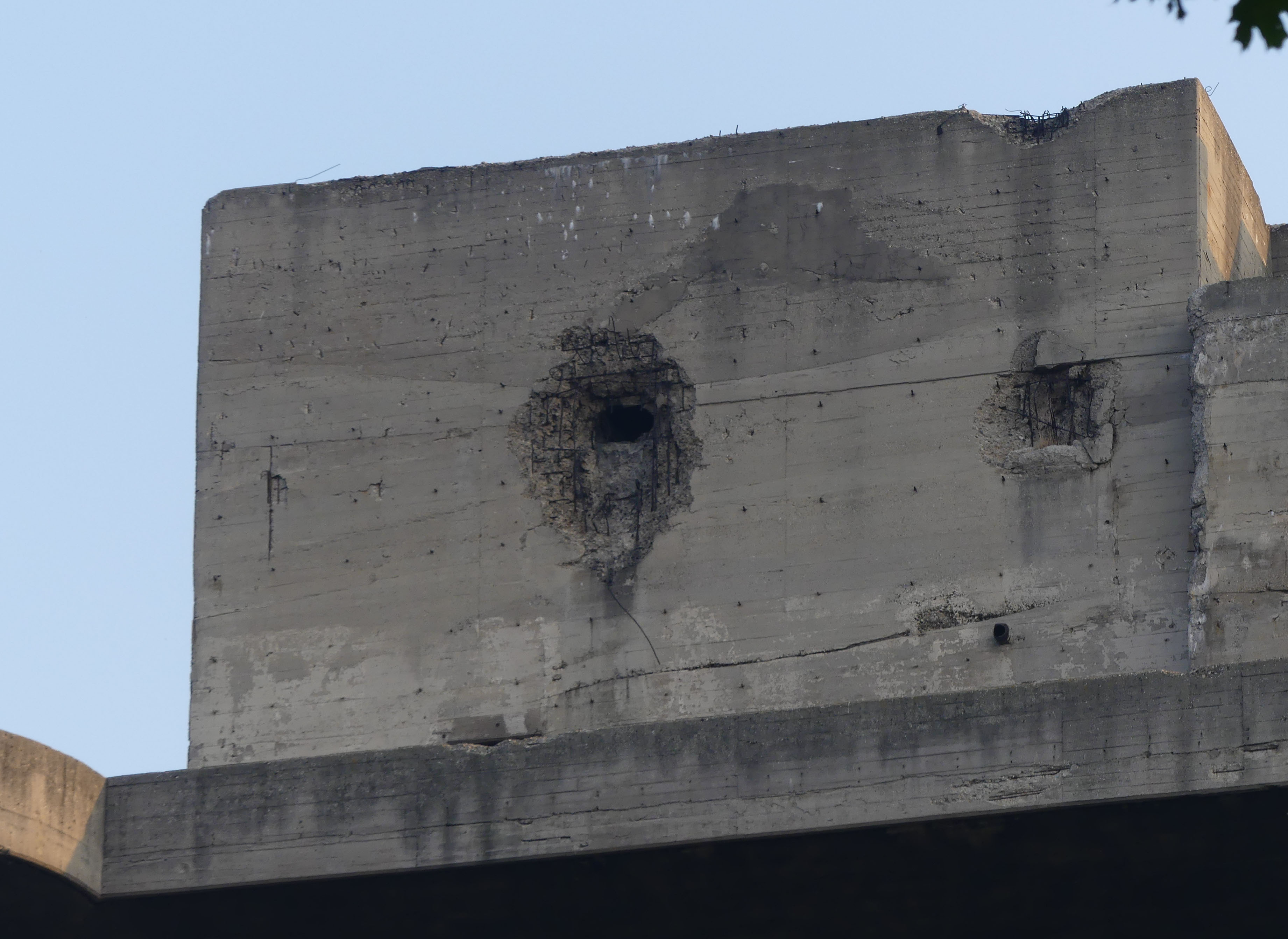
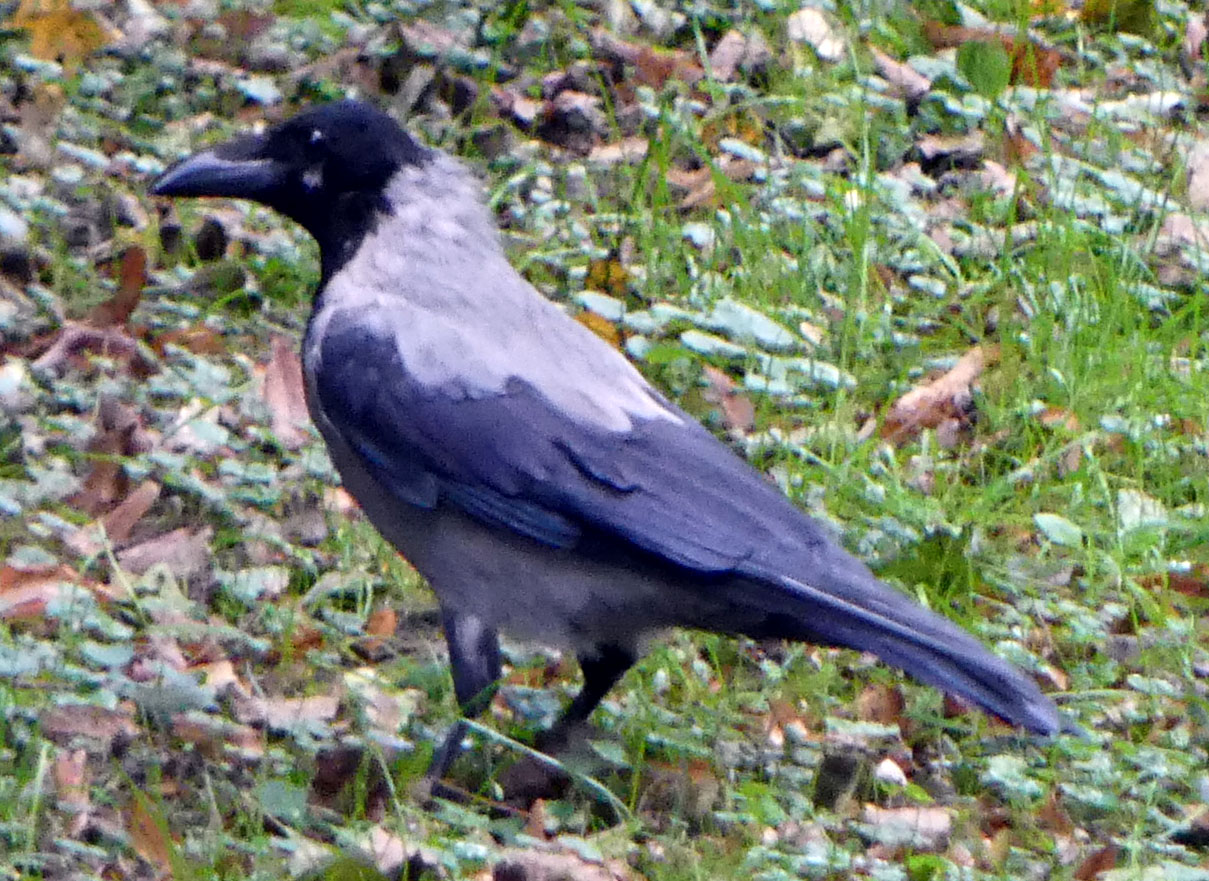
The formal lanes of trees can confuse a newcomer so I use the enormous World War Two flak towers looming over the western side of the gardens as reference points. The entrance to the street or ‘gasse’ we’re staying on is in the opposite direction. Hard to believe now that this area was subject to heavy fighting in 1945 when die-hard Nazis fought the Russians for these massive reinforced concrete anti-aircraft fortresses. You can still see bullet holes and shell craters on the upper levels. Nowadays, the towers provide vantage points for the occasional Peregrine Falcon but little else I think. No Peregrines today, which means birds in the formal gardens might be active. Nothing quietens bird life so much as a cruising falcon with the afterburners on. The park’s  many Hooded Crows, cocky and self-assured, don’t seem bothered by much. I fancy they’d treat the rumour of a raptor with studied disdain.

HddCrw)c218

Hooded Crow

BlackbirdOc1818.jpg

European Blackbird

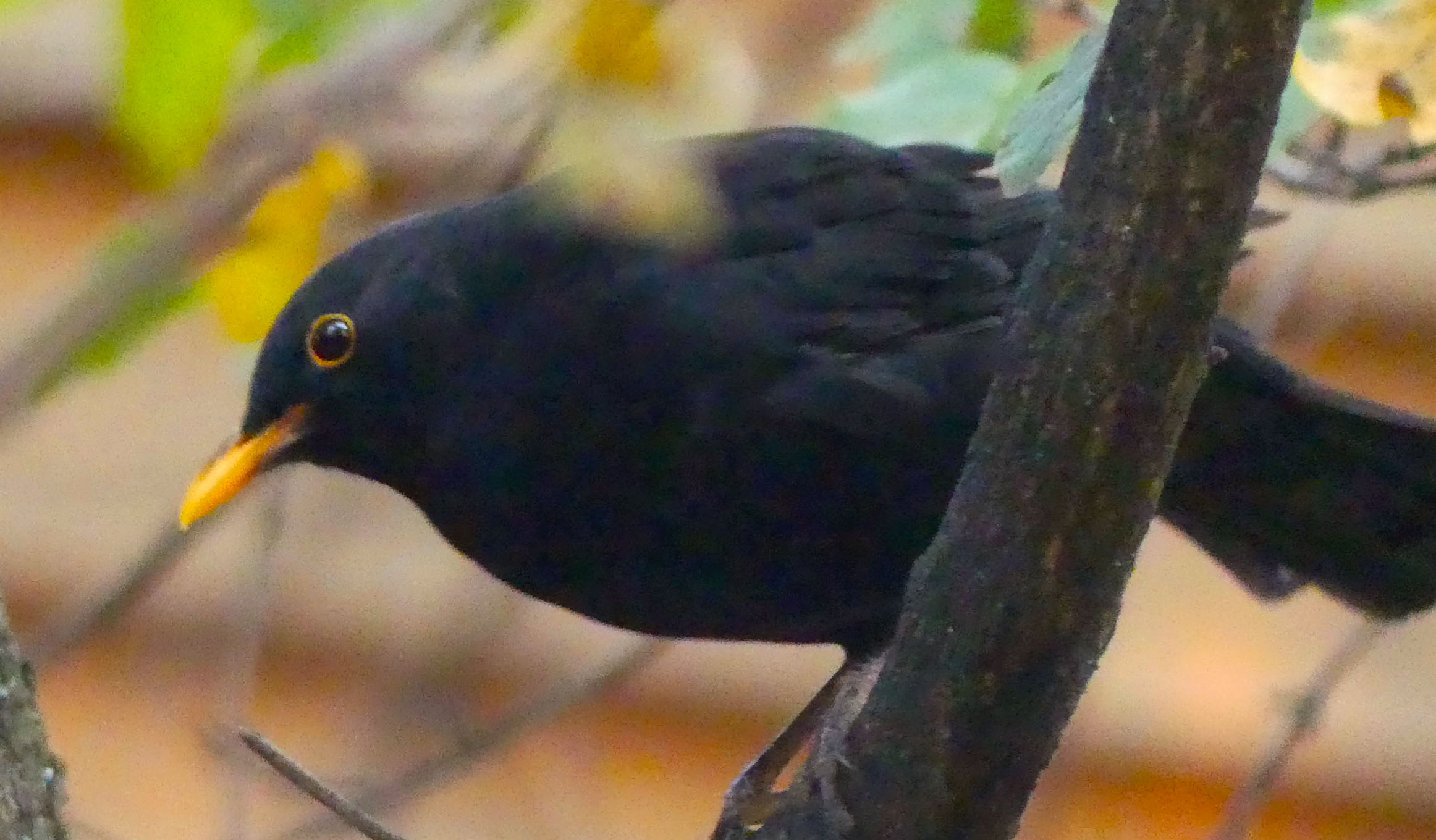
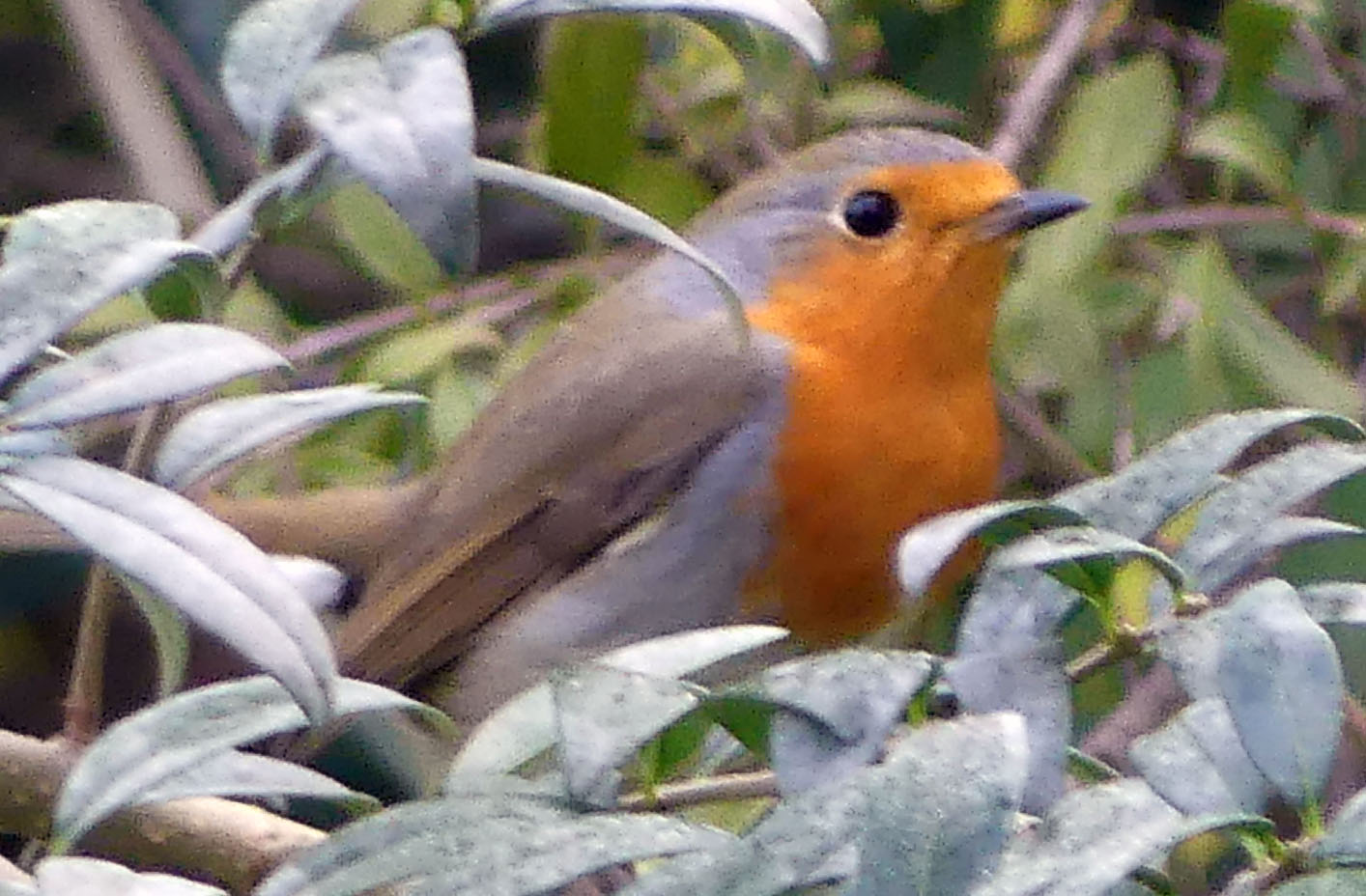
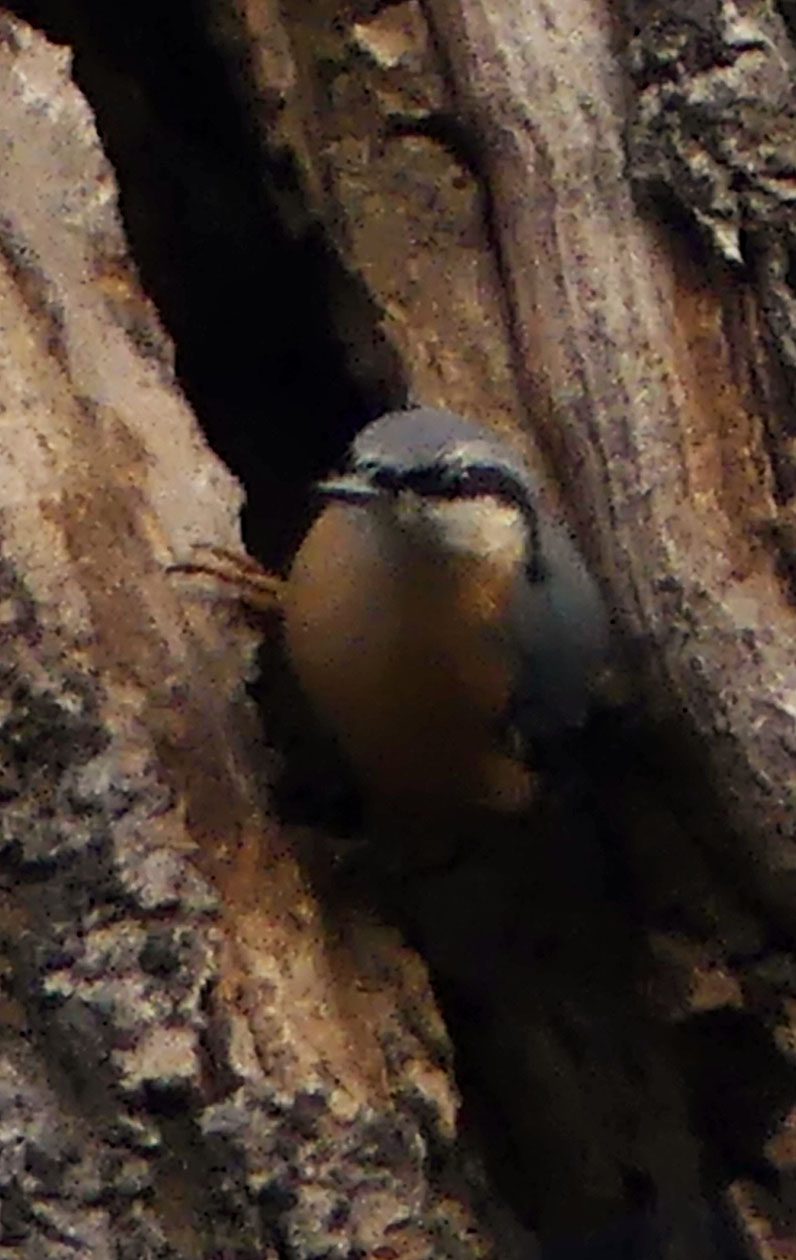
In the cool of early morning I saw few birds and then only briefly but as the sun climbs higher more appear. Even so, an unseasonably warm October has helped trees keep their leaves and their avian residents are hard to spot — noisy but invisible. They have to get hungry and at last they do. A pair of busy Nuthatches investigate a crack in the trunk of a mighty oak. Nearby a squad of European Blackbirds work a patch of shrubbery. A European Robin appears. I still call them English Robins, because my English parents did. Cute little guys — the robins, I mean, not my parents. No relation to our Robins, these birds. Ours are thrushes and kinfolk to European Blackbirds, also thrushes. The Europeans are a kind of flycatcher.

Robin2oc1918

European Robin

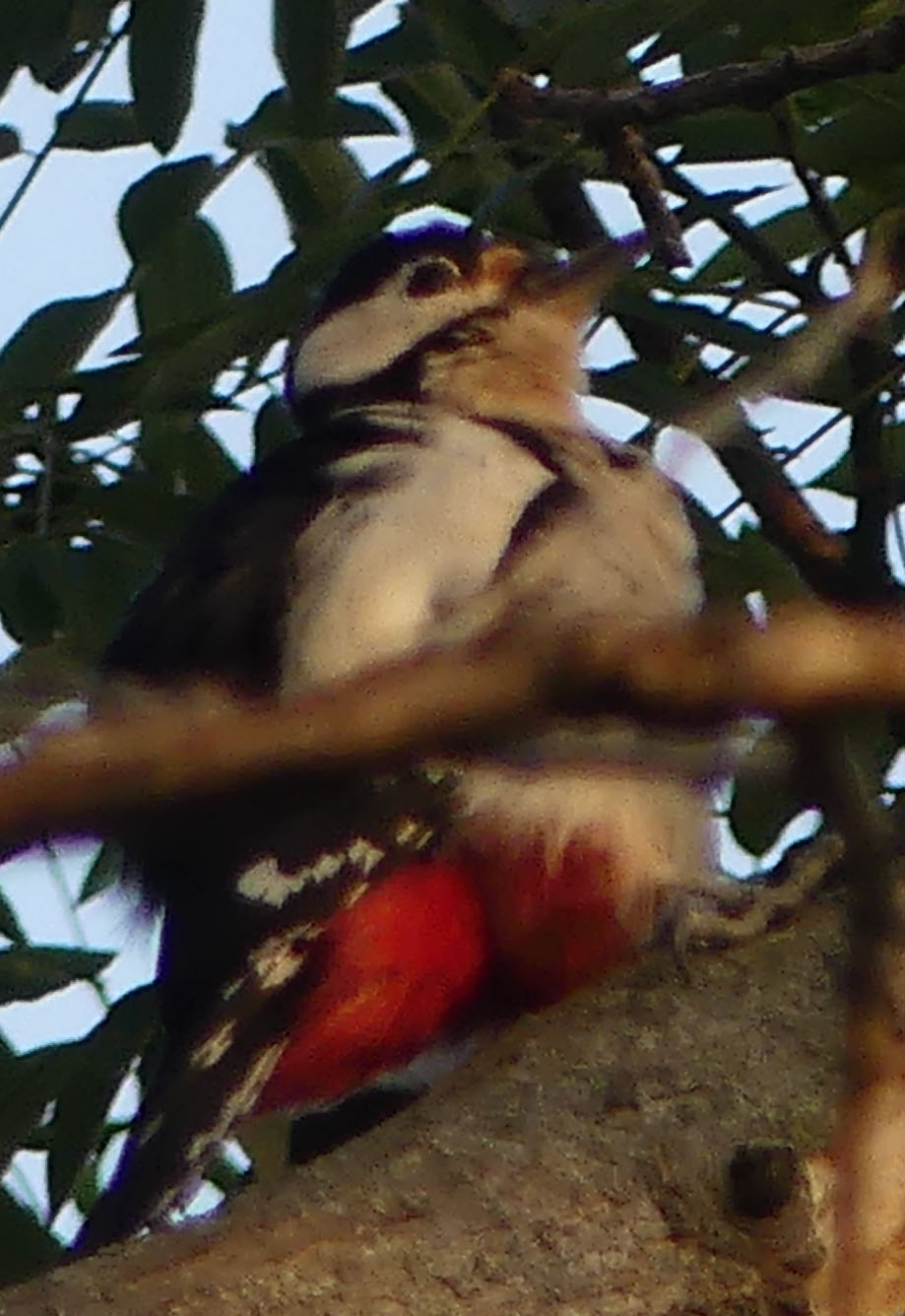
It gets busier as the morning chill lifts. Great Tit fly across the gravelled lanes as they move between forest patches. And there are Blue Tit here too. Related to out Chickadees, they’re busy, hanging from branches and picking up insects lurking on the undersides of leaves. I see several Green Woodpeckers but these large birds vanish into the treetops before I can get a picture. A Great Spotted Woodpecker is more cooperative. This bird makes a guest appearance in the movie ‘The Big Year’ – a non-migratory European bird in western North America. Well, stranger things have happened. And then its time to go, a Viennese coffee and yet another Sacher Torte await. Yes, you can eat Sacher Torte for breakfast.

nuthatch20c1818

Nuthatch

Grtspotwoodoc1818

Great Spotted Woodpecker

blutitoc1918

Blue Tit

Neusiedlersee, Austria

SteppelakewithroeOc418

Burgenland – Salt pond, vineyards and Roe Deer

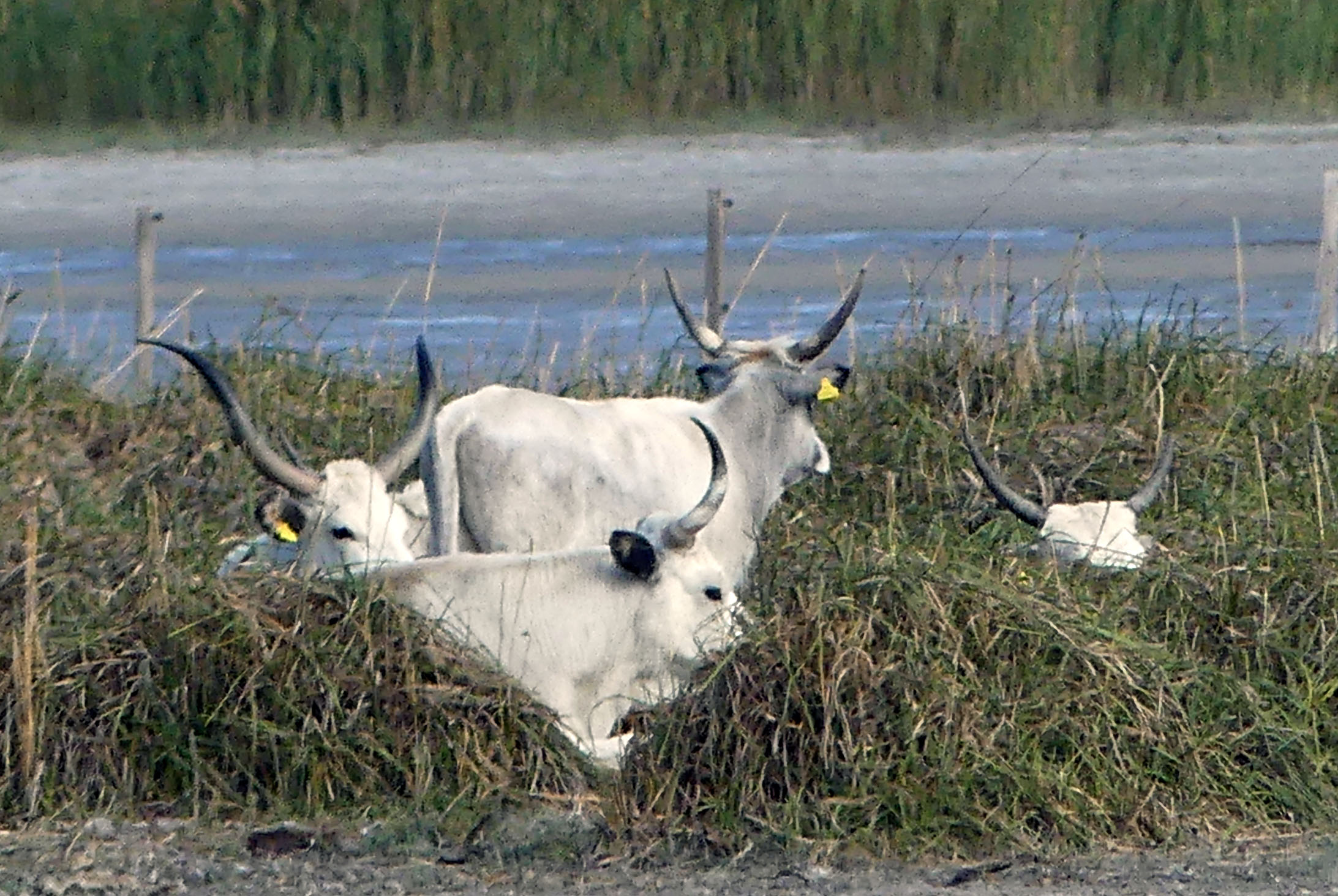
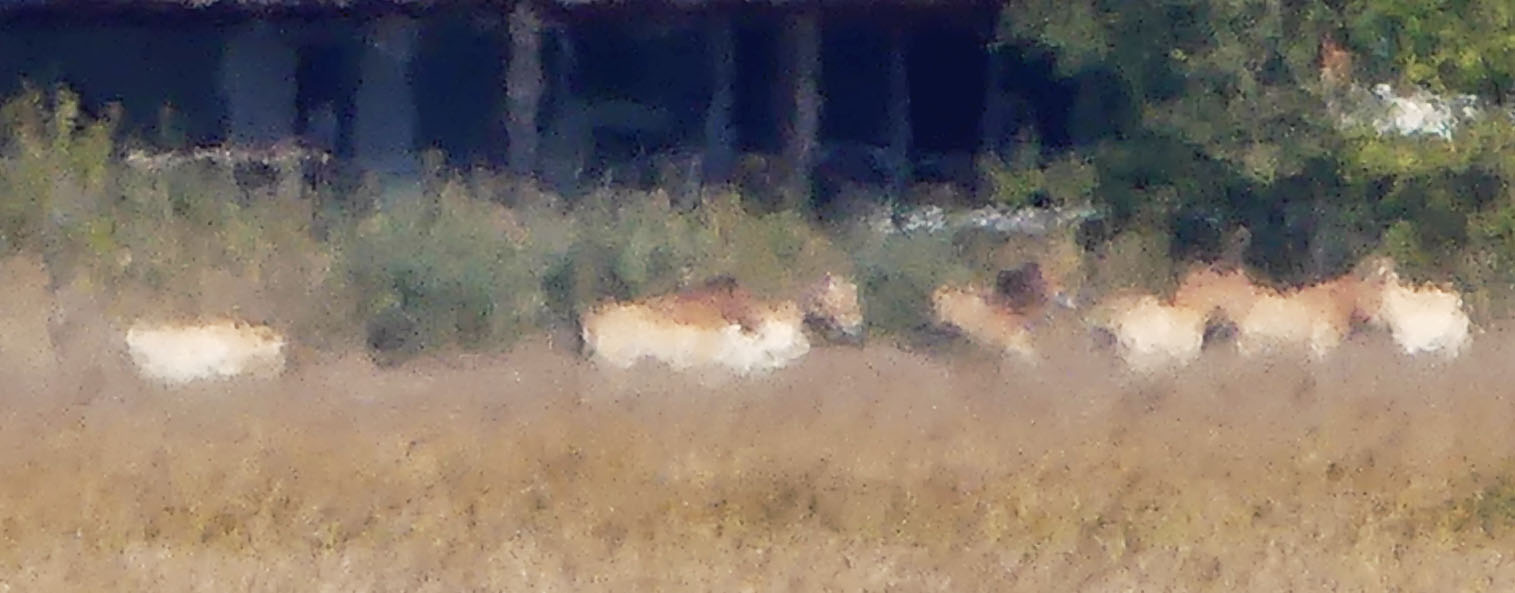
It’s October 4 and it’s late in the year for Austrian birds, especially migrants. To maximize our chances, V and I elect to take a tour with Leander Khil, the author of a (the) book on Austrian birds, to the salt sloughs around Neusiedelersee, Austria’s large, shallow, steppe lake. The National Park here is partly in Hungary and the terrain seems, to us, very Hungarian, an impression reinforced by a herd of Hungarian Grey Cattle. These animals, once common, almost went extinct. They’ve been brought back from the edge, beautiful beasts with cloud-grey hides and long, black-tipped horns. We also spot a herd of Przewalski’s Horse, sometimes abbreviated to P-Horse. They’re  too far off to see properly, much less photograph — a moving band of cinnamon and sand off in the distance. I’m delighted nevertheless. I first read about this last of the wild horse when I was a kid and hoped one day to see them. And now I have.

HgretcatNSDleroc418

Hungarian Grey Cattle

PrzhorseOc418

P-Horse — Last of the Wild Horses

We pass a romantic-looking hut and draw well complete with bucket and beam, protected by law. Although they look traditional they were ‘made up’ for 1950s era films about the Empress Elizabeth, or Sisi, around whom a kind of cult has grown. They’re now preserved as genuine shepherds’ huts rather than film sets and apparently are described so on tourist brochures. I doubt I’ve ever seen a better example of history as a construct. No picture – sorry, Sisi fans.

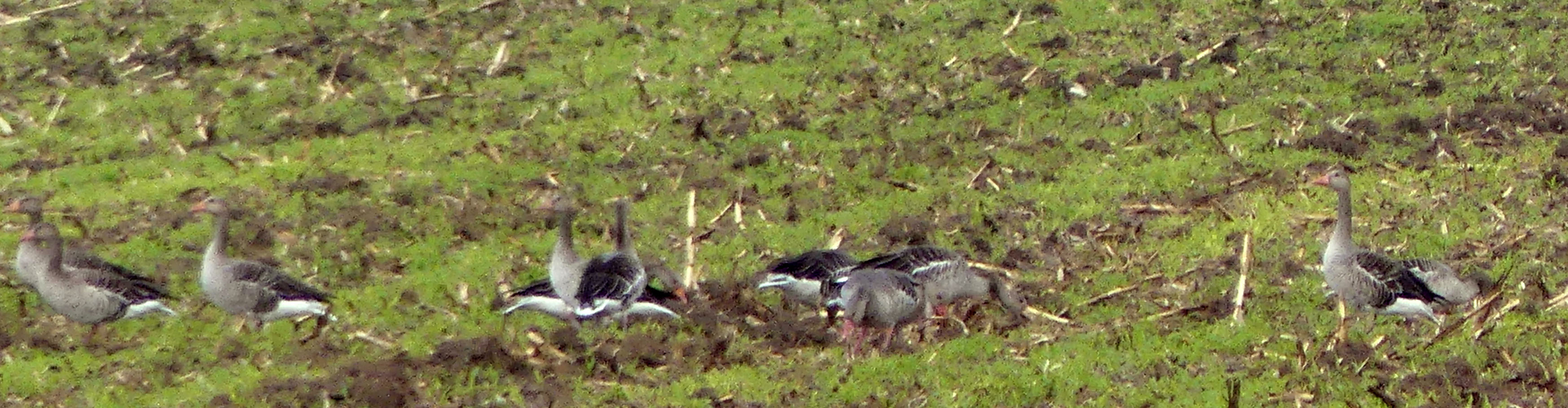
grlggeeseoc418

Greylag Geese

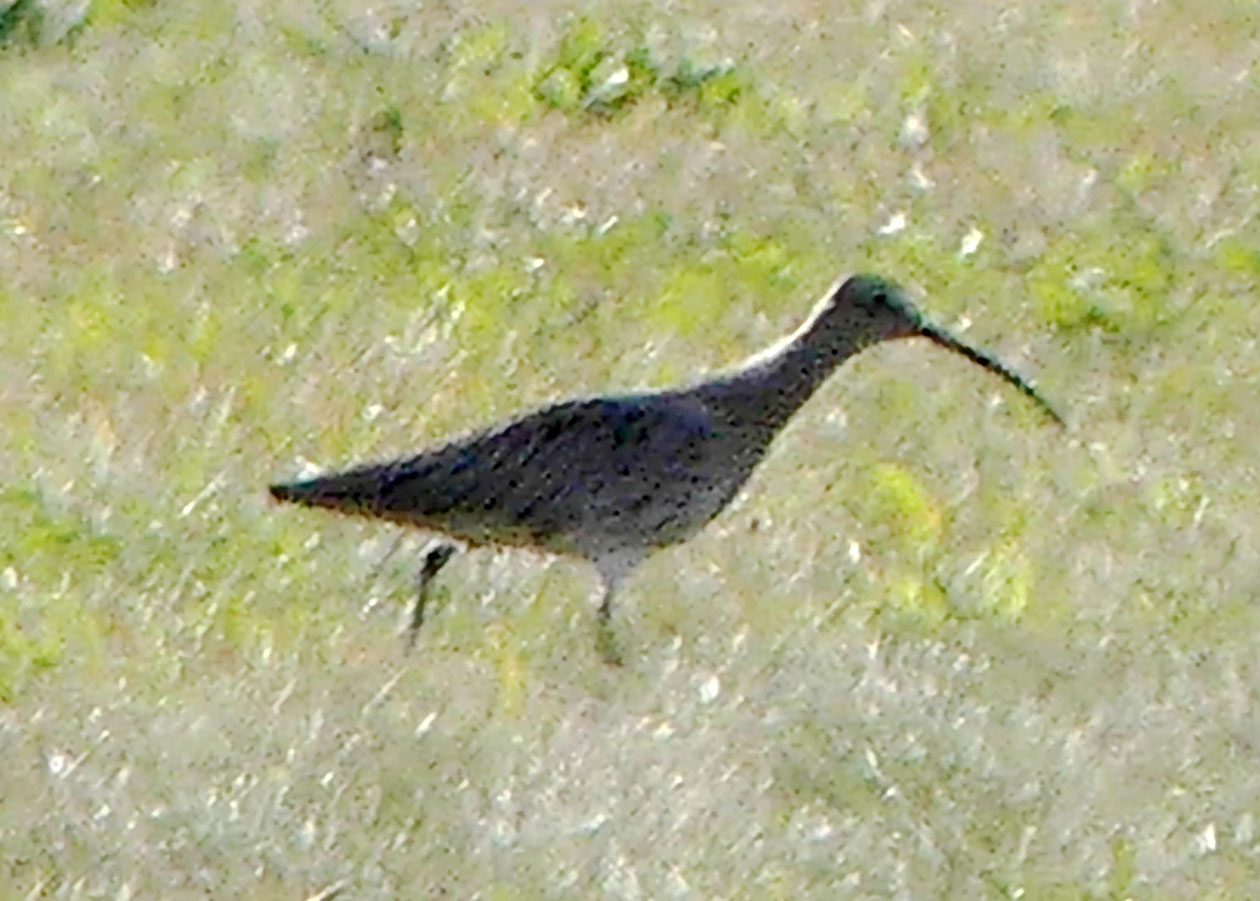
eurcurlwoc418

Curlew

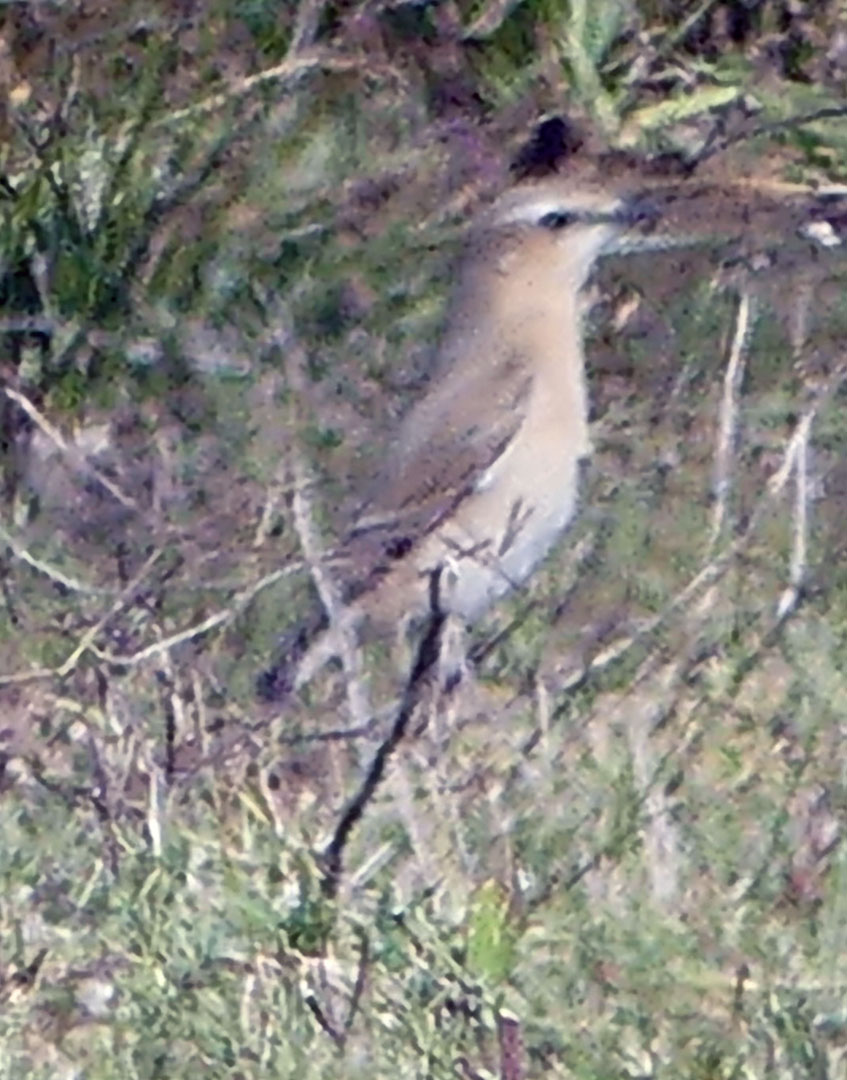
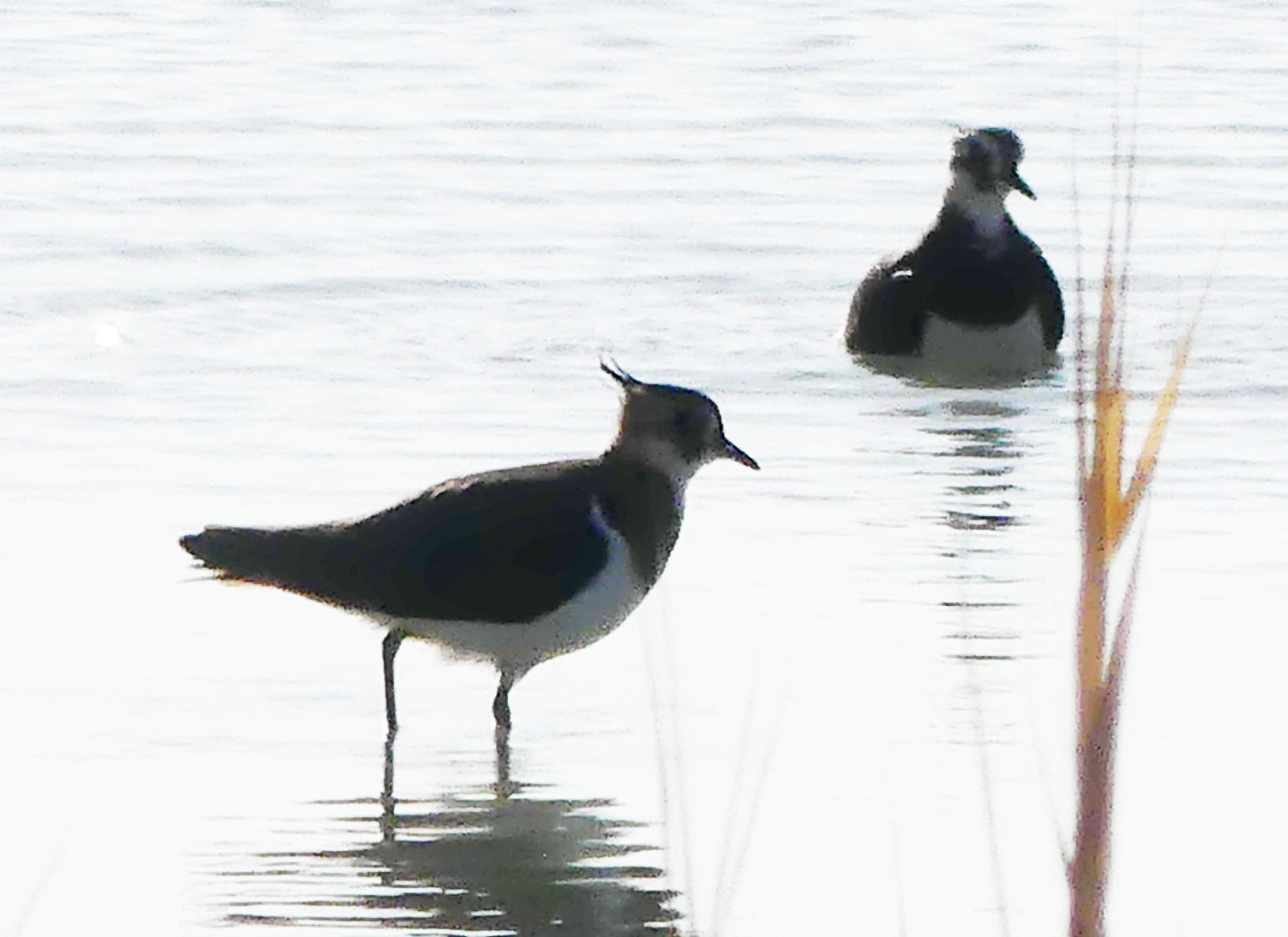
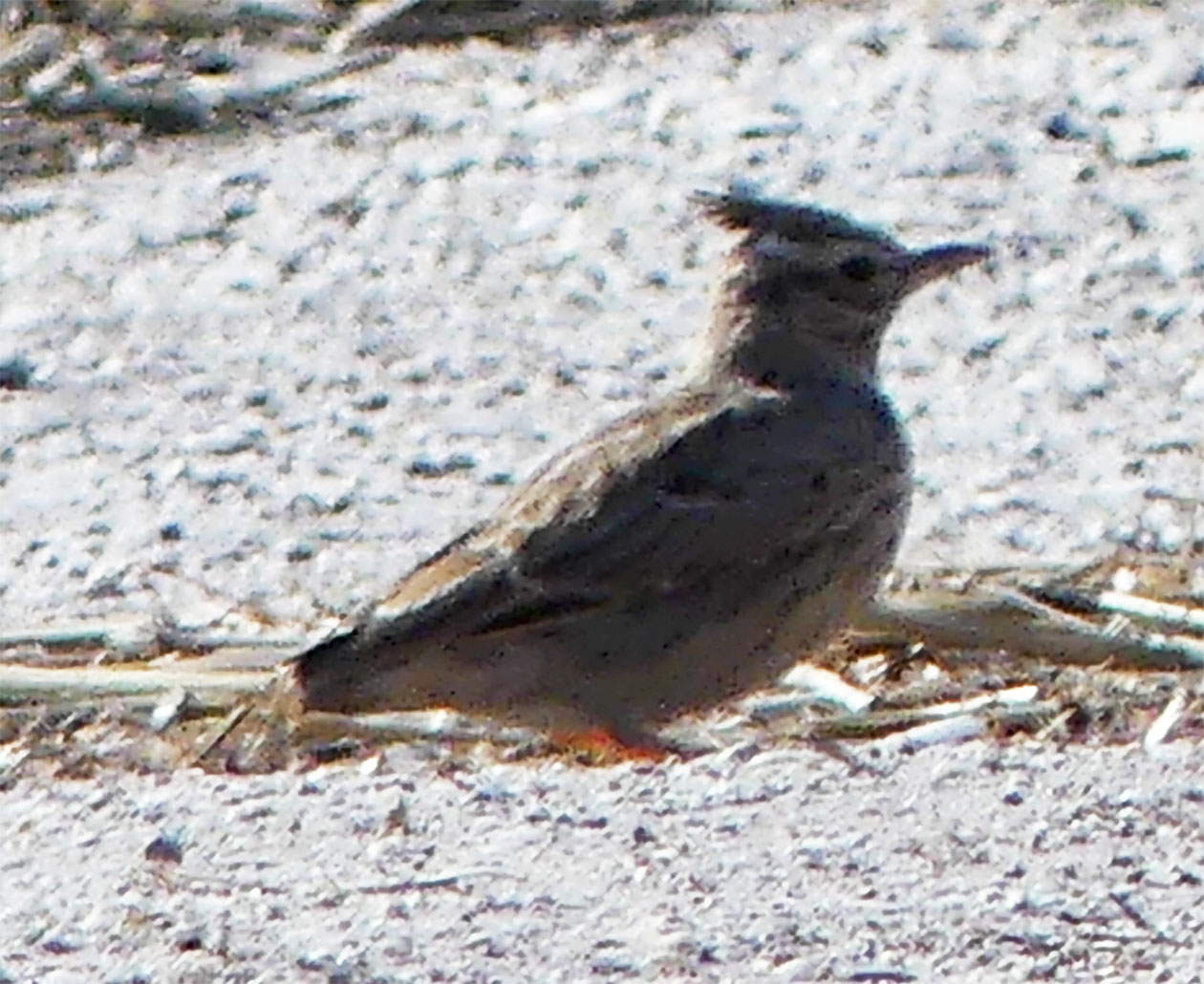
Like most of Europe, Austria has suffered drought for several years. The seasonal salt ponds here have mostly dried up and are empty of shorebirds. A lone Greenshank flies over us, its call reminiscent of our Greater Yellowlegs, its North American cousin. We do spot several Eurasian Curlew happily harvesting bugs from grassy meadows but they’re as happy working the fields as they are the ponds, so the lack of water seems less important to them. Greylag Geese are here in abundance and there are many birds in the air – Skylark, Corn Bunting, European Siskin, Linnet, Goldfinch, Black Redstart and a European Jay. We make a side trip hoping for Crested lark. At first, nothing, but then one scampers out from behind a hay bale, followed by several more. Lovely birds with their pronounced crests. I’m fond of birds with crests. Cedar waxwings are one of my favourite birds. Northern Lapwings, fashionable crests blowing in the breeze, join the favourites list.

crstlarkoc418

Crested Lark

whtearoc418

Wheatear

Lawngs)c418

Northern Lapwings

whtwagtlOc418

White Wagtail

Crnbuntoc418

Corn Bunting

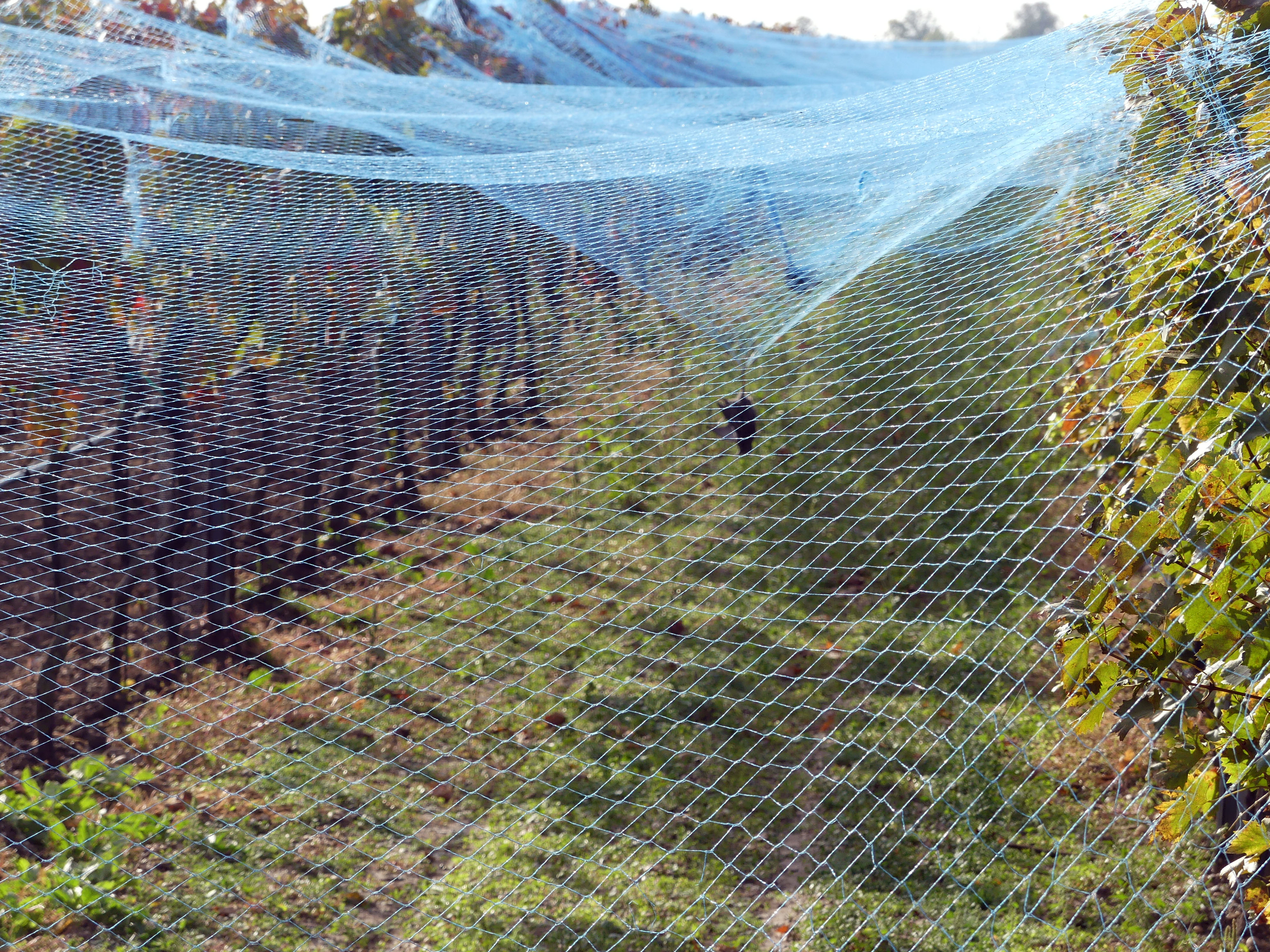
Because the National Park is a late development, much of it consists of scattered patches interrupted by vineyards, their berries protected with nets. Sometimes farmers droop acres of large mesh nets over and between rows and kill hundreds of birds. Proper netting procedure protects the fruit much better and doesn’t destroy birdlife.

netbird0c418

The Wrong Way to Protect Grapes

LngerdowlOc418

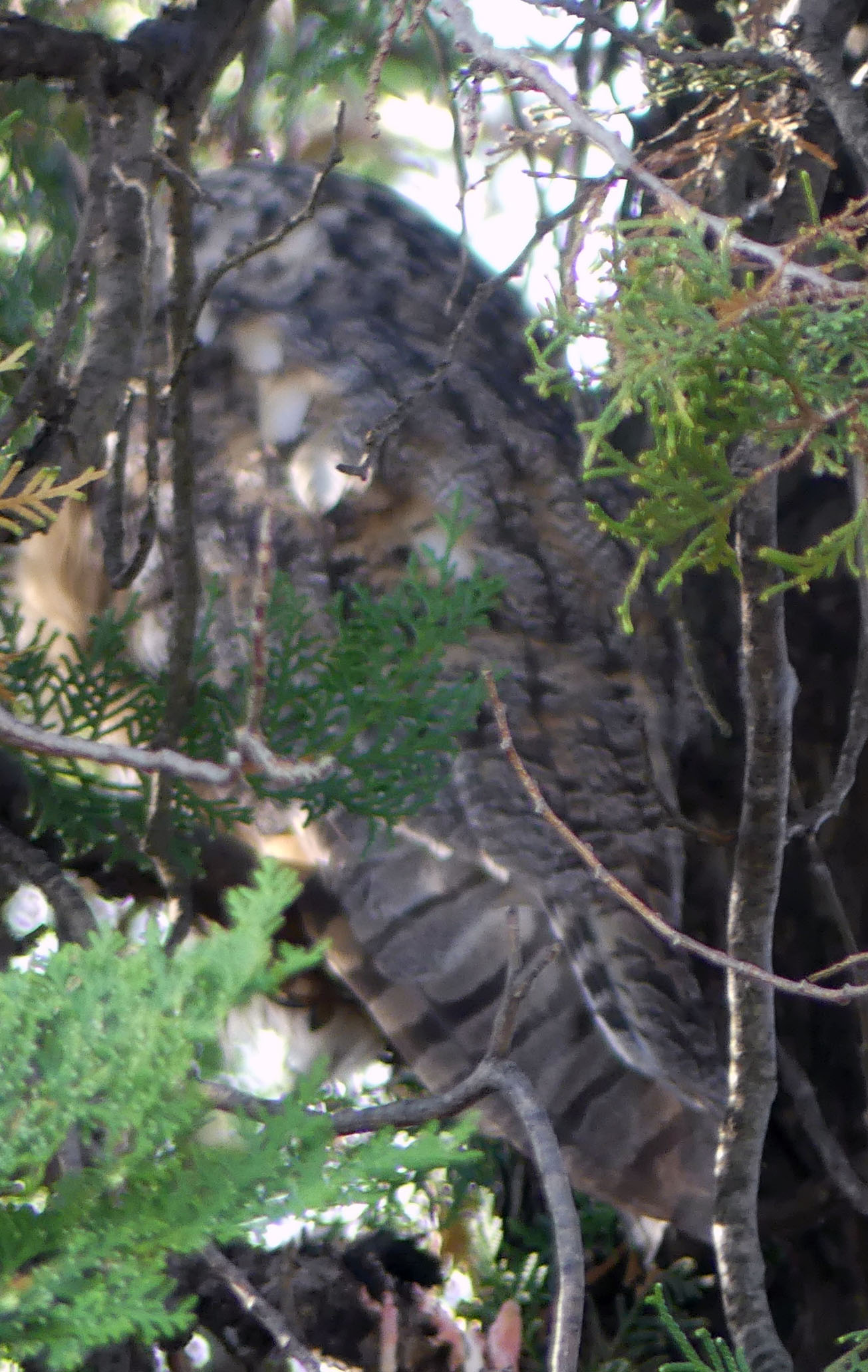
Long-eared Owl

We side trip to a village cemetery where people are hard at work cleaning and maintaining graves, so unlike what generally happens in North America. We’re here for Long-eared Owls, which roost in this graveyard in winter. It’s V. who spots the first and then a second and finally a third. Even when she points them out to me I find it hard to see the birds. The owls located, Leander takes to a wayside with a view for a delicious lunch of local products provide by St. Martin’s Therme and Lodge. Fantastic. Thanks Leander for being such an excellent and knowledgeable guide!