More images from Texas Wildlife Refuges…

White Ibis

Common Gallinule

Little Blue Heron
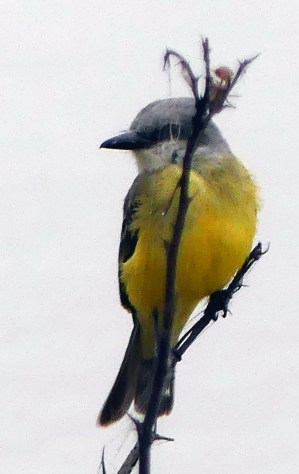
Couch’s Kingbird
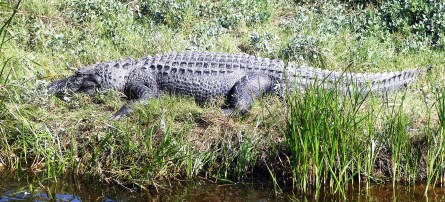
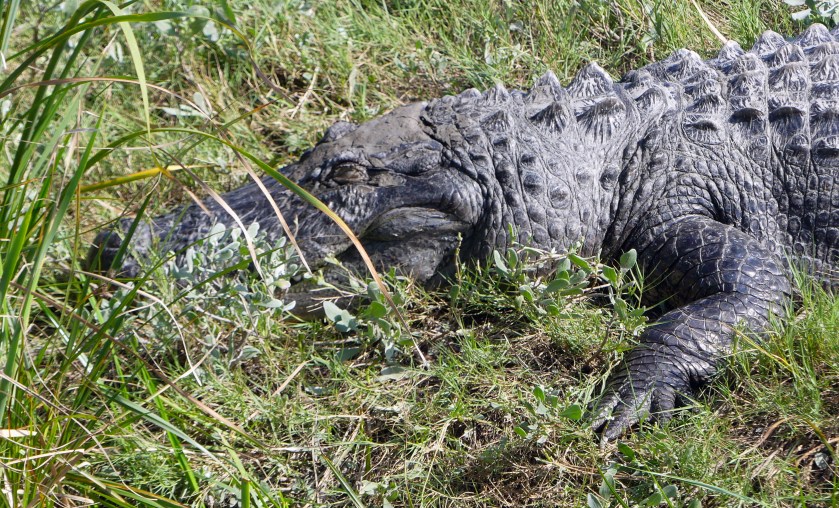
No Swimming!
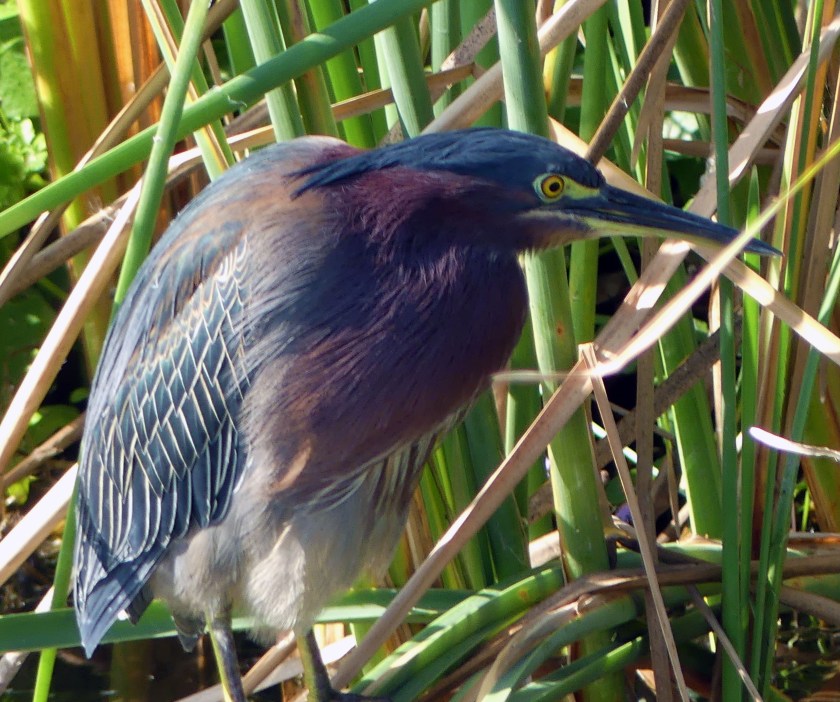
Green Heron

Long-tailed Skipper
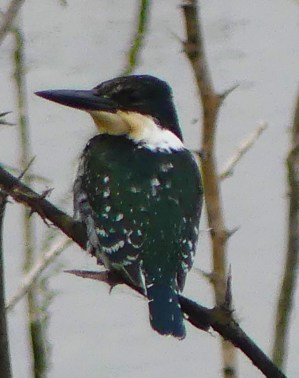
Green Kingfisher
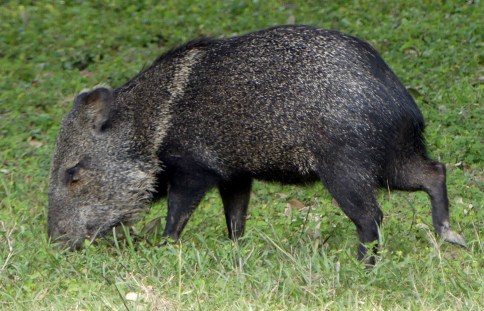
Javelina

Vermilion Flycatcher
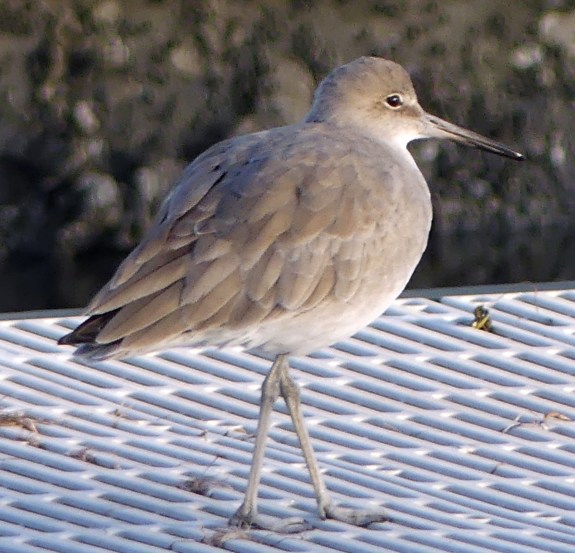
Willet
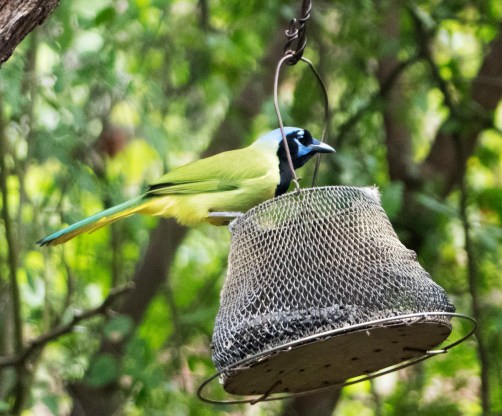
Green Jay
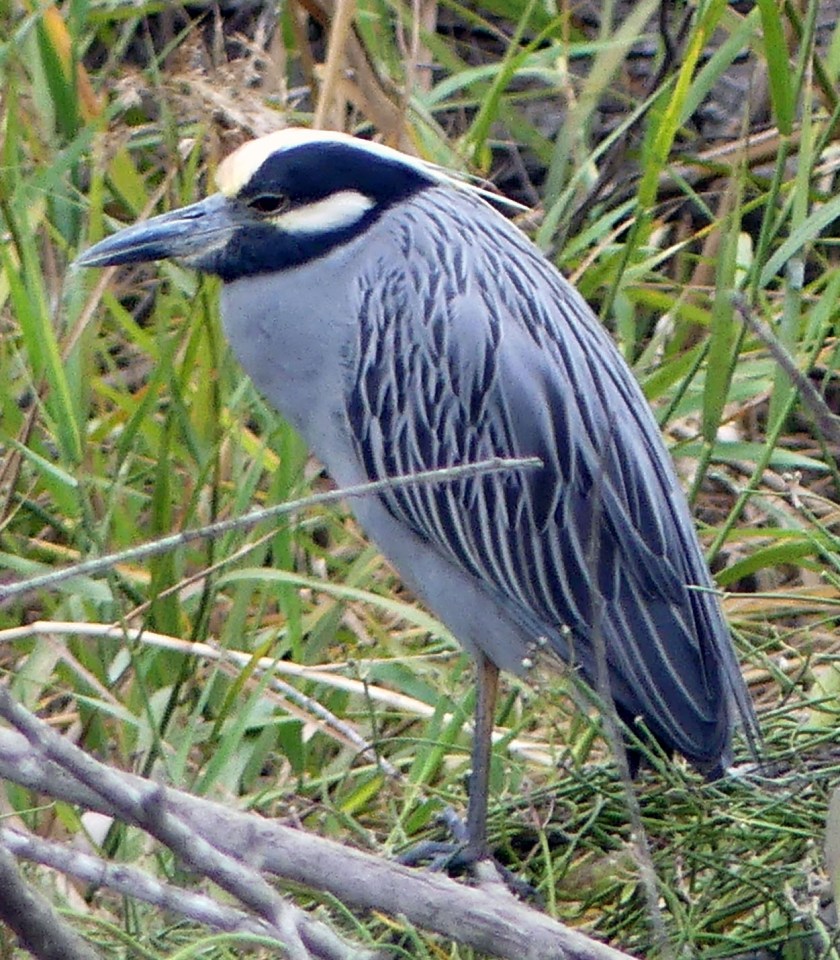
Yellow-crowned Night Heron
More images from Texas Wildlife Refuges…
White Ibis
Common Gallinule
Little Blue Heron
Couch’s Kingbird
No Swimming!
Green Heron
Long-tailed Skipper
Green Kingfisher
Javelina
Vermilion Flycatcher
Willet
Green Jay
Yellow-crowned Night Heron
Nice to get back to the Rio Grande Valley for a few days to visit the wonderful wildlife refuges where so many beautiful birds and butterflies find sanctuary …
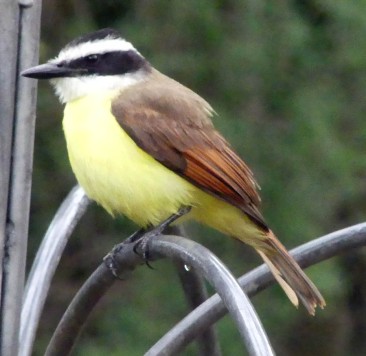
Great Kiskadee
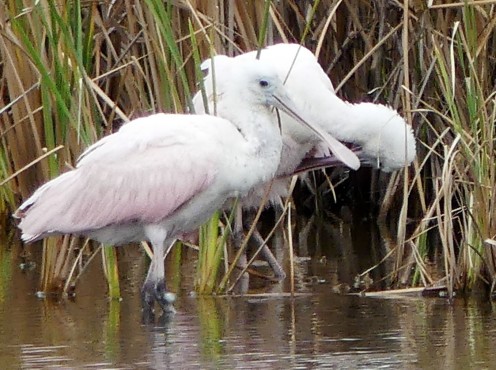
Roseate Spoonbills
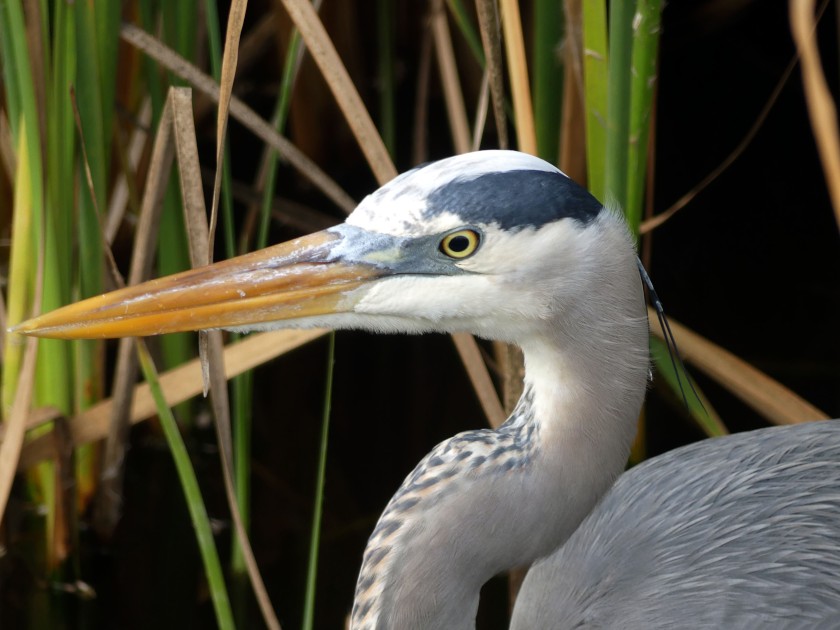
Great Blue Heron
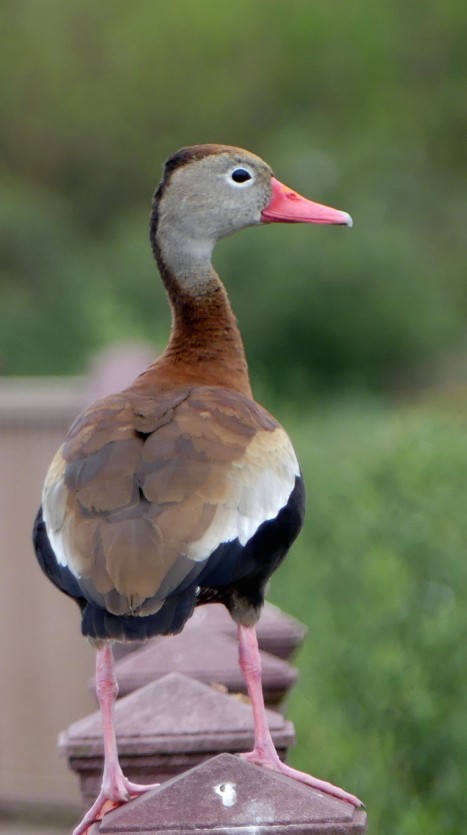
Black-bellied Whistling Duck
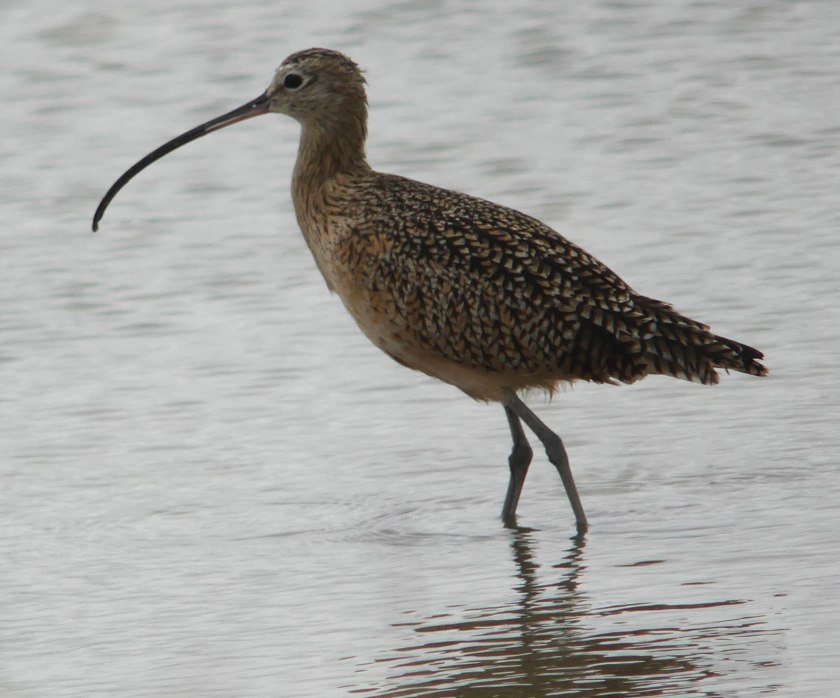
Long-billed Curlew
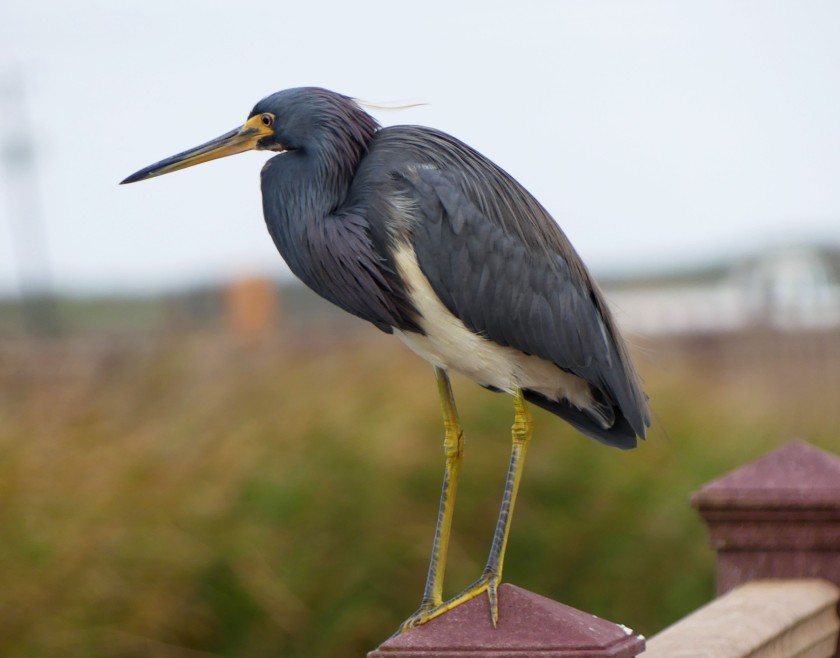
Tricolored Heron
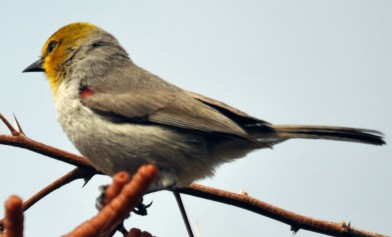
Verdin
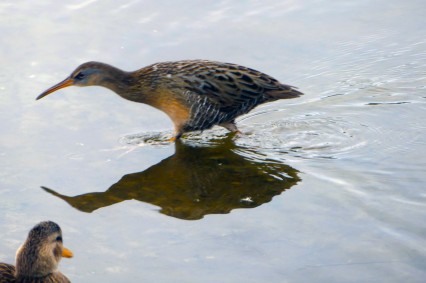
Clapper Rail
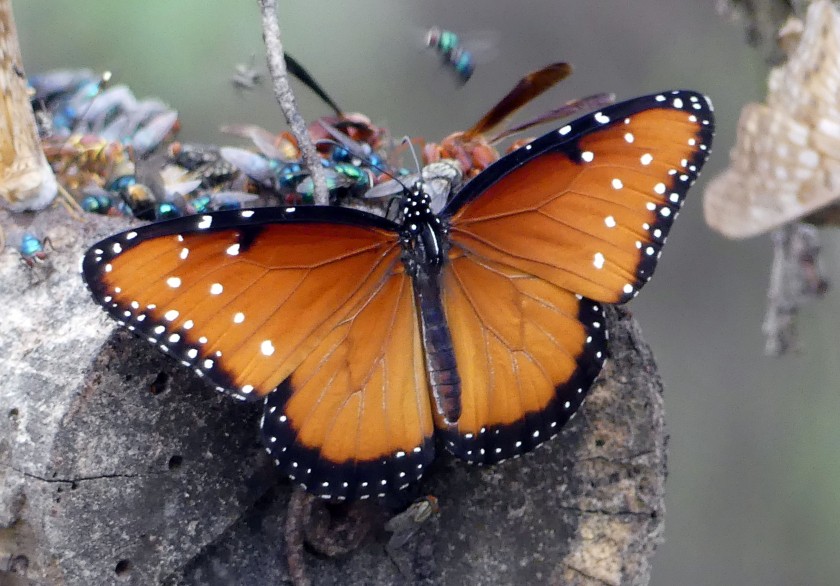
Queen Butterfly
Yesterday we had storms here and the rain bucketed down. Today, morning sunlight penetrates even the densest thickets. After a seriously wet day, Golden-crowned Sparrows feed as if making up for lost time. We tend to overlook common birds though many are strikingly beautiful.

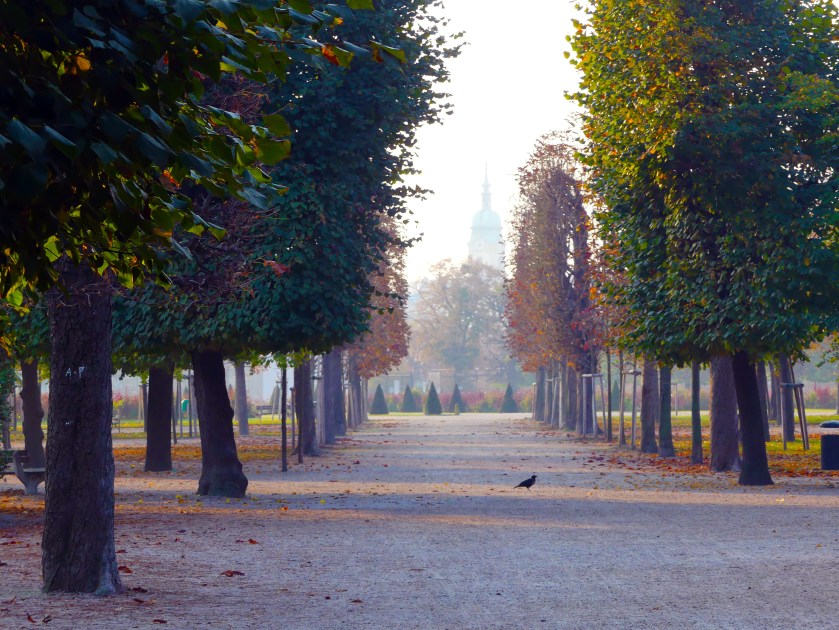
Augarten Park, Vienna
I’m up early hoping to pick up a few Vienna birds before Augarten Park wakes up. The preschool isn’t yet open and early morning joggers are few. Likewise, the porcelain manufactory in Augarten Palace (established in the 18th century) is still closed. So is its pleasant cafe, which is too bad. You can buy a teacup in the shop for 500 euro (sans tea) here if that’s your thing.
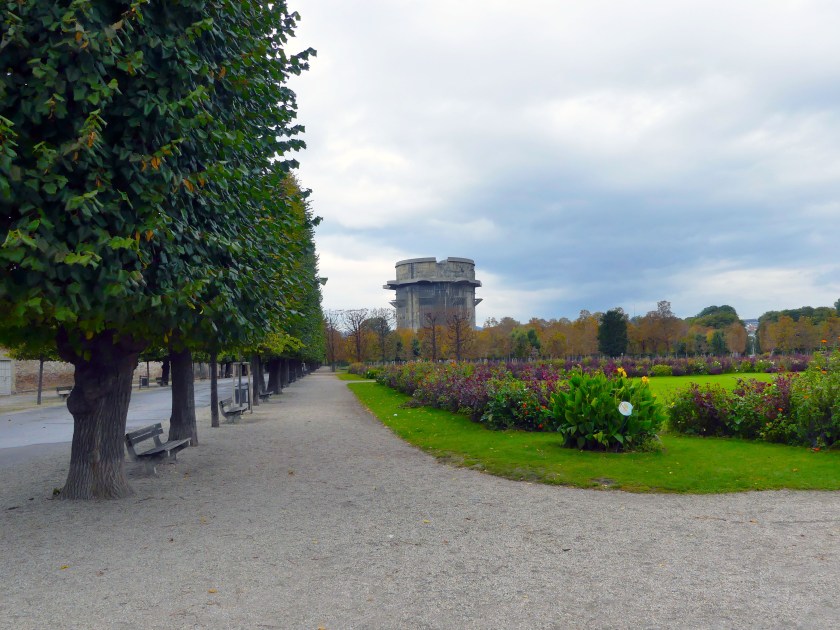
Flak Tower
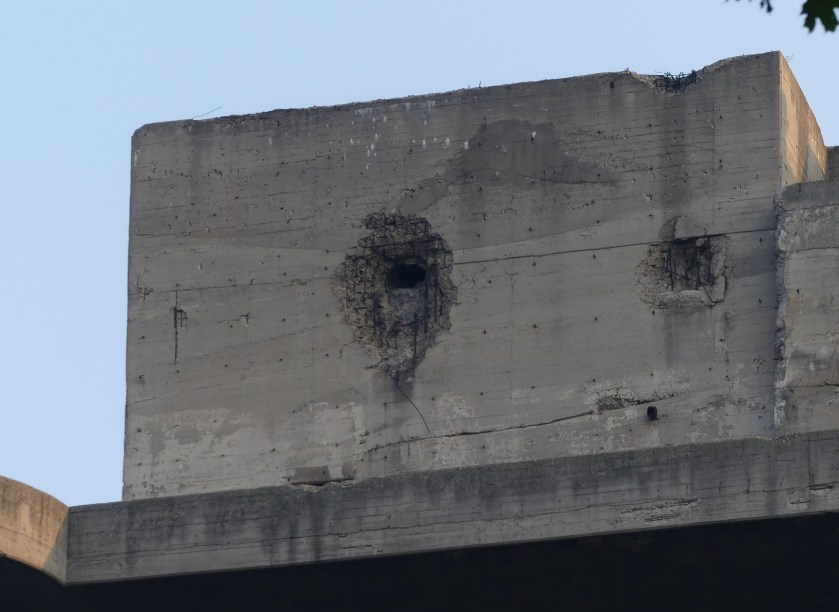
The formal lanes of trees can confuse a newcomer so I use the enormous World War Two flak towers looming over the western side of the gardens as reference points. The entrance to the street or ‘gasse’ we’re staying on is in the opposite direction. Hard to believe now that this area was subject to heavy fighting in 1945 when die-hard Nazis fought the Russians for these massive reinforced concrete anti-aircraft fortresses. You can still see bullet holes and shell craters on the upper levels. Nowadays, the towers provide vantage points for the occasional Peregrine Falcon but little else I think. No Peregrines today, which means birds in the formal gardens might be active. Nothing quietens bird life so much as a cruising falcon with the afterburners on. The park’s many Hooded Crows, cocky and self-assured, don’t seem bothered by much. I fancy they’d treat the rumour of a raptor with studied disdain.

Hooded Crow
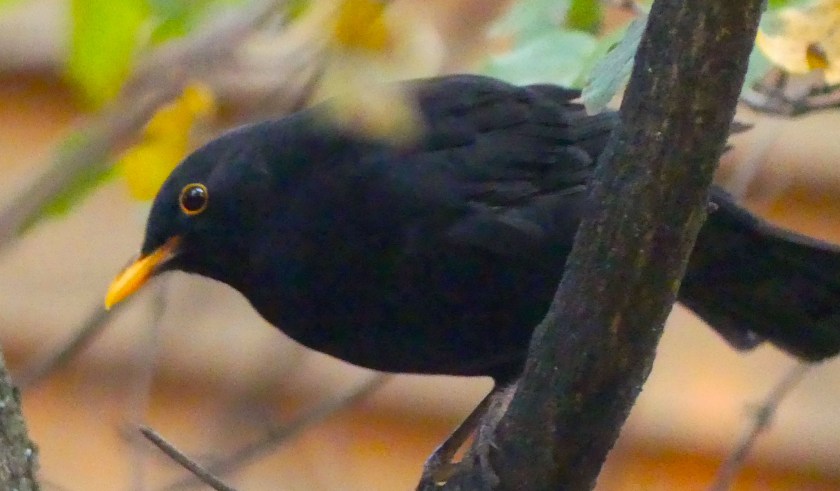
European Blackbird
In the cool of early morning I saw few birds and then only briefly but as the sun climbs higher more appear. Even so, an unseasonably warm October has helped trees keep their leaves and their avian residents are hard to spot — noisy but invisible. They have to get hungry and at last they do. A pair of busy Nuthatches investigate a crack in the trunk of a mighty oak. Nearby a squad of European Blackbirds work a patch of shrubbery. A European Robin appears. I still call them English Robins, because my English parents did. Cute little guys — the robins, I mean, not my parents. No relation to our Robins, these birds. Ours are thrushes and kinfolk to European Blackbirds, also thrushes. The Europeans are a kind of flycatcher.

European Robin
It gets busier as the morning chill lifts. Great Tit fly across the gravelled lanes as they move between forest patches. And there are Blue Tit here too. Related to out Chickadees, they’re busy, hanging from branches and picking up insects lurking on the undersides of leaves. I see several Green Woodpeckers but these large birds vanish into the treetops before I can get a picture. A Great Spotted Woodpecker is more cooperative. This bird makes a guest appearance in the movie ‘The Big Year’ – a non-migratory European bird in western North America. Well, stranger things have happened. And then its time to go, a Viennese coffee and yet another Sacher Torte await. Yes, you can eat Sacher Torte for breakfast.

Nuthatch
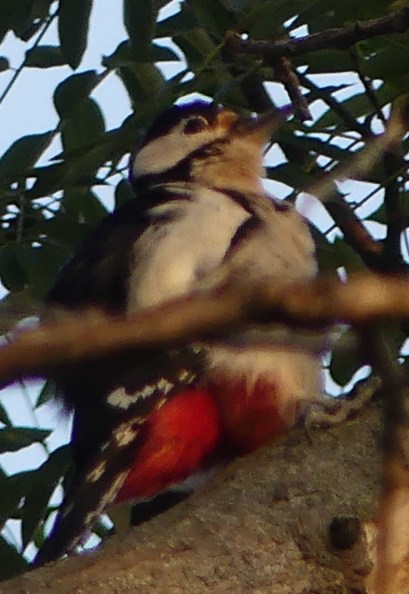
Great Spotted Woodpecker
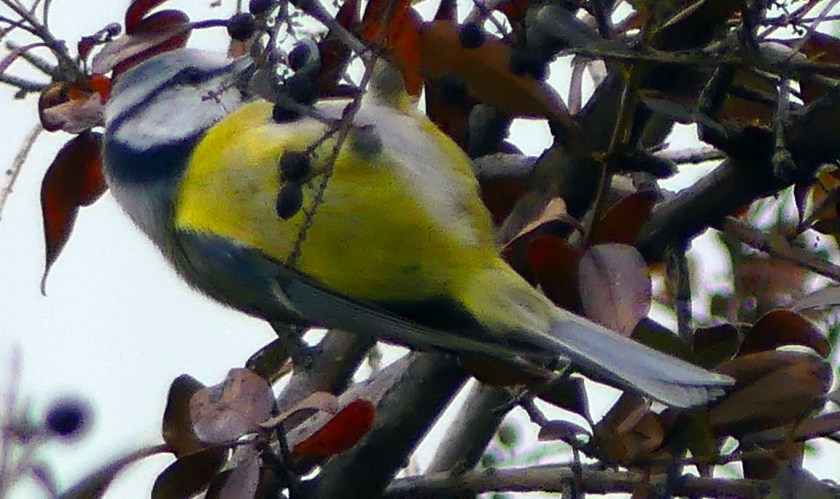
Blue Tit
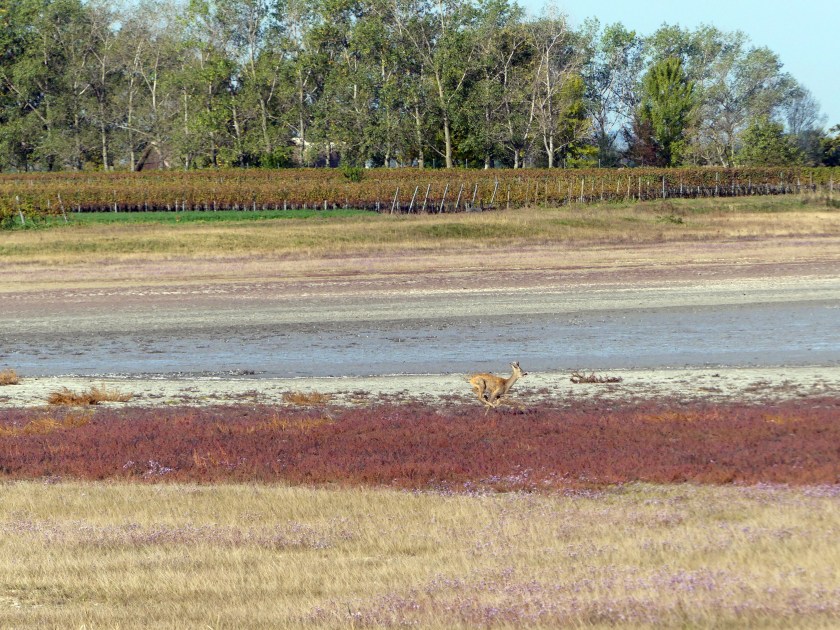
Burgenland – Salt pond, vineyards and Roe Deer
It’s October 4 and it’s late in the year for Austrian birds, especially migrants. To maximize our chances, V and I elect to take a tour with Leander Khil, the author of a (the) book on Austrian birds, to the salt sloughs around Neusiedelersee, Austria’s large, shallow, steppe lake. The National Park here is partly in Hungary and the terrain seems, to us, very Hungarian, an impression reinforced by a herd of Hungarian Grey Cattle. These animals, once common, almost went extinct. They’ve been brought back from the edge, beautiful beasts with cloud-grey hides and long, black-tipped horns. We also spot a herd of Przewalski’s Horse, sometimes abbreviated to P-Horse. They’re too far off to see properly, much less photograph — a moving band of cinnamon and sand off in the distance. I’m delighted nevertheless. I first read about this last of the wild horse when I was a kid and hoped one day to see them. And now I have.
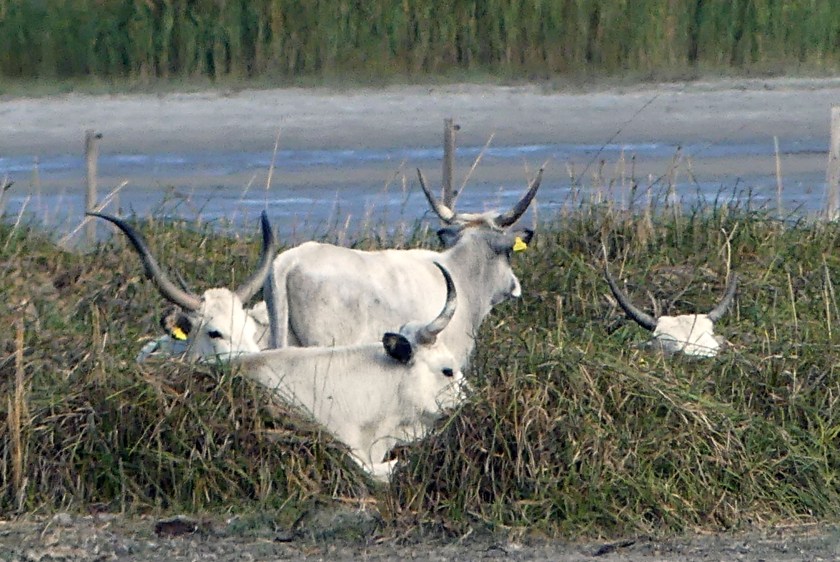
Hungarian Grey Cattle
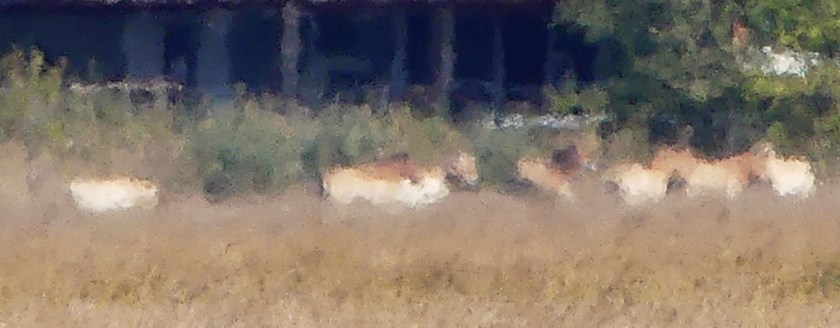
P-Horse — Last of the Wild Horses
We pass a romantic-looking hut and draw well complete with bucket and beam, protected by law. Although they look traditional they were ‘made up’ for 1950s era films about the Empress Elizabeth, or Sisi, around whom a kind of cult has grown. They’re now preserved as genuine shepherds’ huts rather than film sets and apparently are described so on tourist brochures. I doubt I’ve ever seen a better example of history as a construct. No picture – sorry, Sisi fans.

Greylag Geese
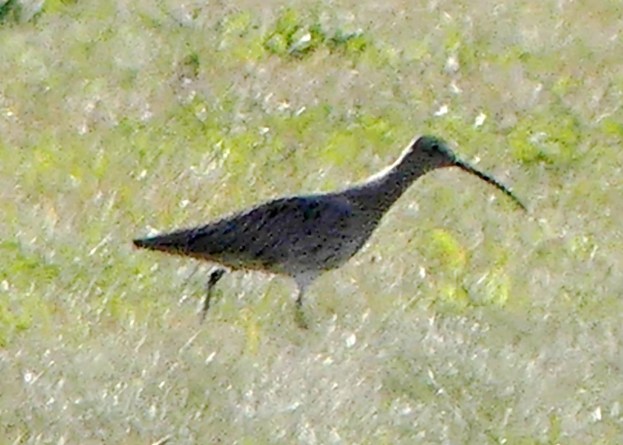
Curlew
Like most of Europe, Austria has suffered drought for several years. The seasonal salt ponds here have mostly dried up and are empty of shorebirds. A lone Greenshank flies over us, its call reminiscent of our Greater Yellowlegs, its North American cousin. We do spot several Eurasian Curlew happily harvesting bugs from grassy meadows but they’re as happy working the fields as they are the ponds, so the lack of water seems less important to them. Greylag Geese are here in abundance and there are many birds in the air – Skylark, Corn Bunting, European Siskin, Linnet, Goldfinch, Black Redstart and a European Jay. We make a side trip hoping for Crested lark. At first, nothing, but then one scampers out from behind a hay bale, followed by several more. Lovely birds with their pronounced crests. I’m fond of birds with crests. Cedar waxwings are one of my favourite birds. Northern Lapwings, fashionable crests blowing in the breeze, join the favourites list.
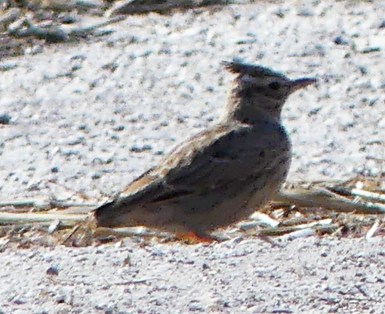
Crested Lark
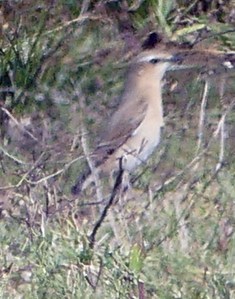
Wheatear
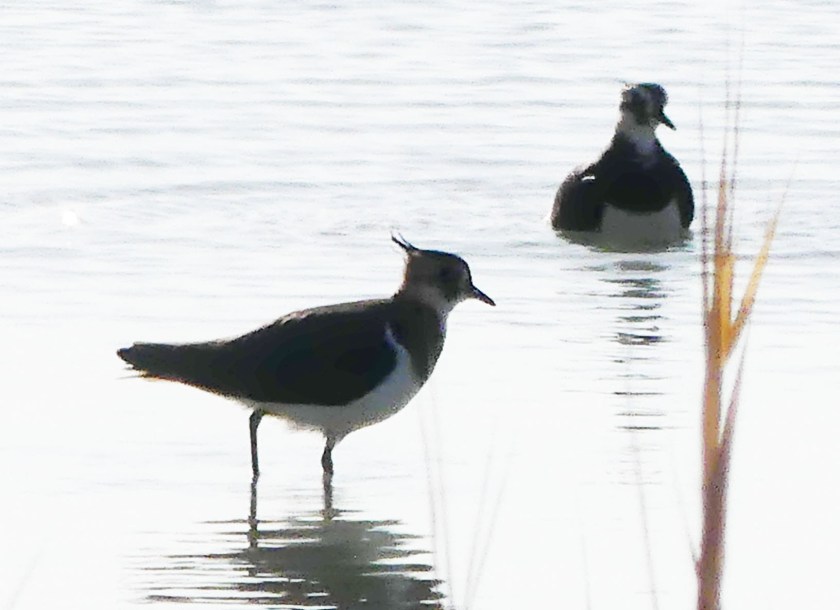
Northern Lapwings
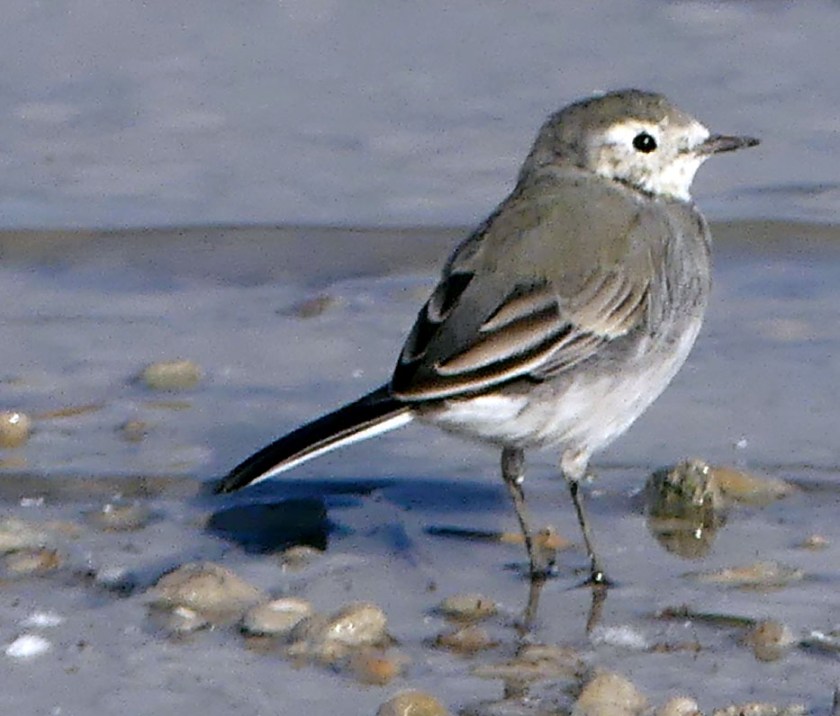
White Wagtail
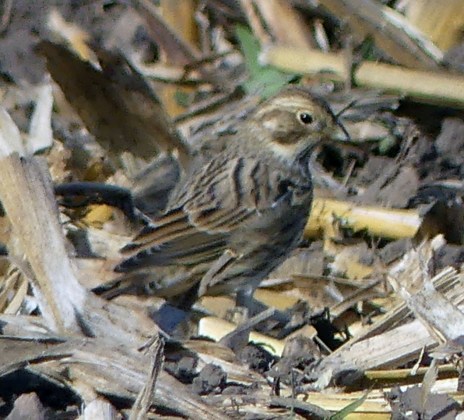
Corn Bunting
Because the National Park is a late development, much of it consists of scattered patches interrupted by vineyards, their berries protected with nets. Sometimes farmers droop acres of large mesh nets over and between rows and kill hundreds of birds. Proper netting procedure protects the fruit much better and doesn’t destroy birdlife.
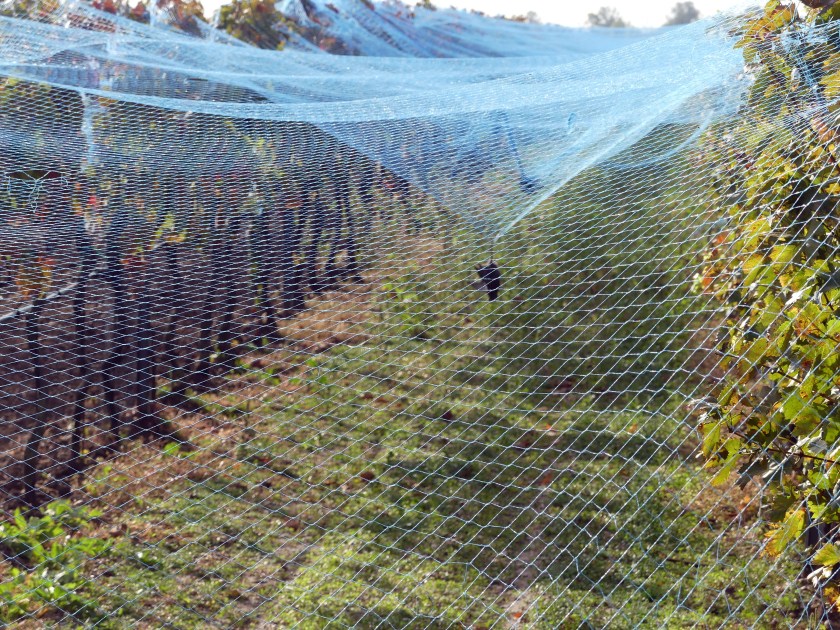
The Wrong Way to Protect Grapes
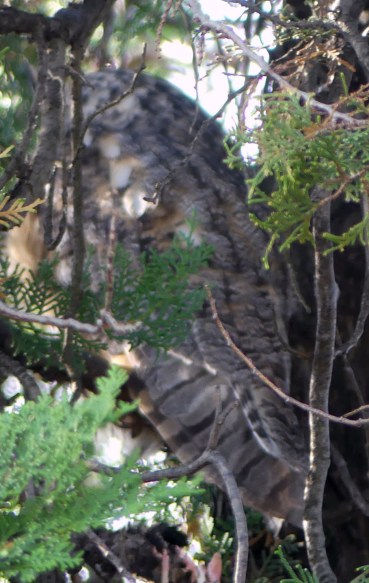
Long-eared Owl
We side trip to a village cemetery where people are hard at work cleaning and maintaining graves, so unlike what generally happens in North America. We’re here for Long-eared Owls, which roost in this graveyard in winter. It’s V. who spots the first and then a second and finally a third. Even when she points them out to me I find it hard to see the birds. The owls located, Leander takes to a wayside with a view for a delicious lunch of local products provide by St. Martin’s Therme and Lodge. Fantastic. Thanks Leander for being such an excellent and knowledgeable guide!
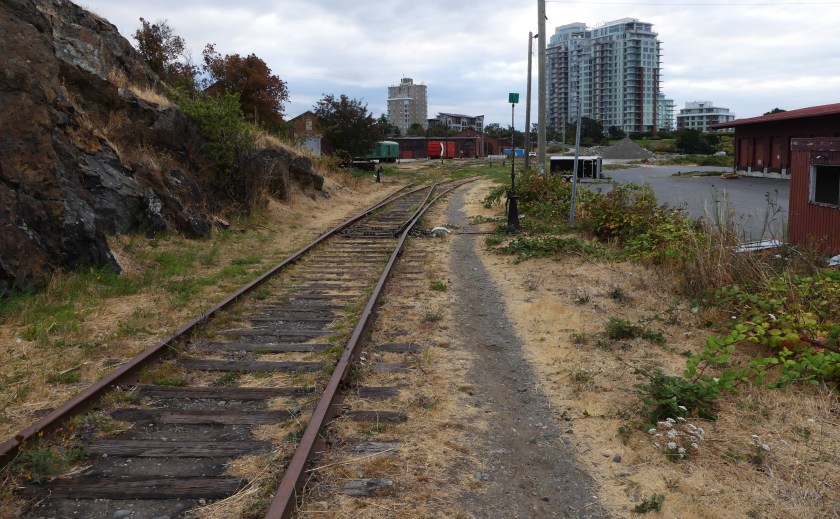
Roundhouse Railyards
A warm late summer day, or will be once the sun is up. September has a faded glory I especially like, with a touch of melancholy in it — a string quartet replacing summer’s brass band. Today I’m searching for rare sparrows, a Brewer’s at Panama Flats and a Lark Sparrow at the old rail yards in Vic West. Both birds are common in Arizona, certainly not here. I try for the Lark first. The yard is more or less deserted but there are zero birds up yet. After three quarters of an hour of fruitless searching, I’m ready to give up. I’m almost back at the car when I see a single bird coming in, a sparrow from its undulating flight. It lands next to the open door of a construction worker’s pickup, ignores the heavy metal music emanating from within, and begins to feed. It’s the Lark. Birds are weird sometimes! More and more pickups arrive and the noise level rises. Time to move on to Panama Flats and some peace and quiet. The Lark Sparrow couldn’t care less about that, apparently.


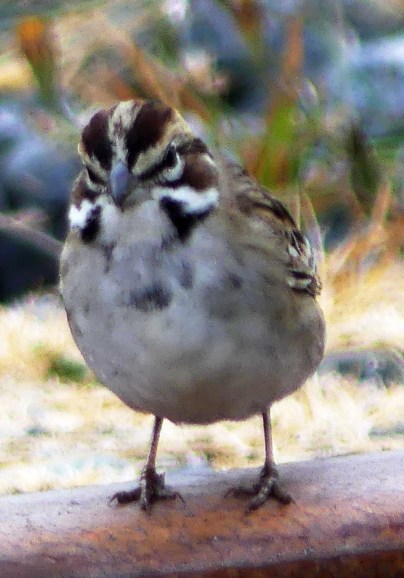
Lark Sparrow
At the Flats it’s warmer and brighter. The wintertime wet meadows are now dry fields, knee-deep in snow-white Chamomile with their butter-yellow centers. The flowers’ powerful musky perfume, if ‘perfume’ is the right word, clings to my clothing as I wade through. Not unpleasant but strong!
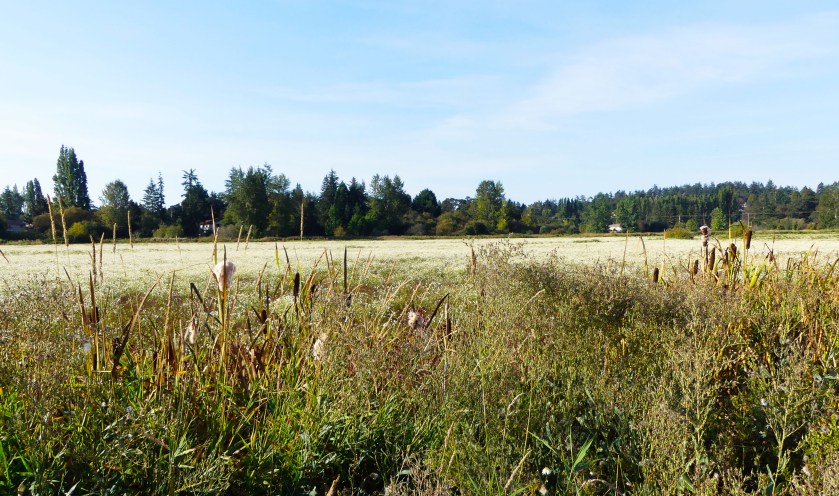
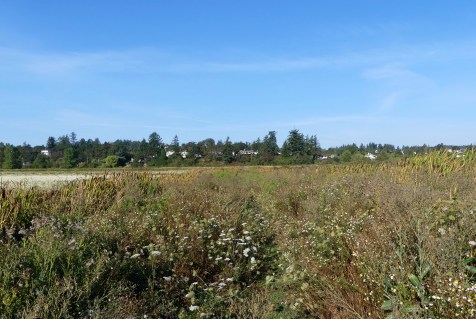
Panama Flats
Head-high Cattails, Queen Ann’s Lace, Horse-weed and Thistle, crowd in along the dyke trail. A pudgy vole sees me just in time and panics, his round rear end (is bum inappropriate?) disappearing into the weeds. I track him through rustling leaves, scurrying loudly away. He needs to be more careful. A Northern Harrier just floated past and there’s a dark Merlin hunting nearby, lightning fast and deadly. Incautious voles don’t last long anywhere.
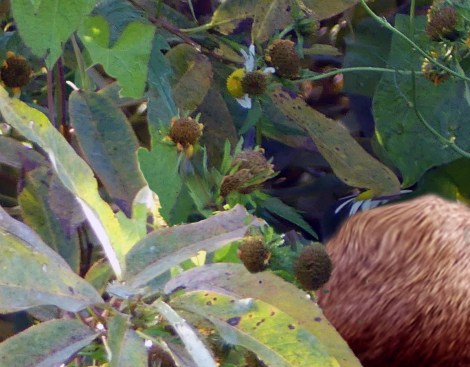
Vole in a Hurry (recreation)
This is sparrow land. I catch a glimpse of the Brewer’s in a stunted willow but mostly it’s Savannah, White-crowned and Lincoln’s Sparrows that populate the Flats, shooting left and right out of the taller vegetation like tiny, spring-loaded feathered missiles. Lots of Goldfinches here too, flitting through the branches of the taller willows. It’s the end of summer and birds are gathering for pre-migration, a wonderful time. The rains will come soon, the rampant plant growth will die down and the ponds will refill just in time to welcome the flocks of returning waterfowl and shore birds.

Savannah Sparrow
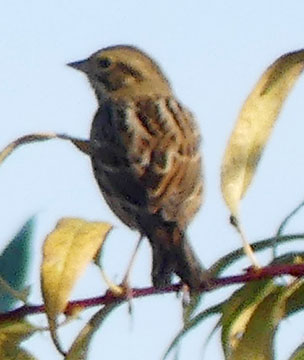
Lincoln’s Sparrow
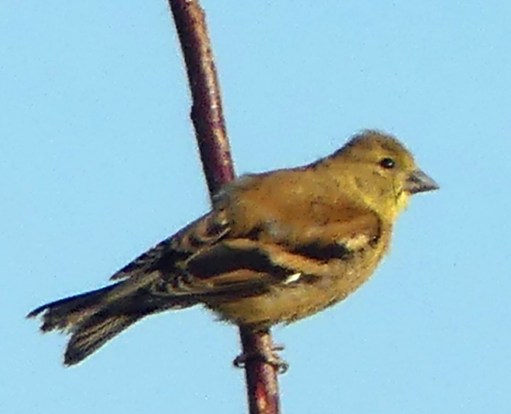
Goldfinch
I’m scratching, alternating between the mosquito bite on the heel of my hand and those on my ankles. Makes me think back to when my mom used to dot us boys with calamine lotion, which helped, I think, but not much. We had lots of mosquitoes where I grew up. In summer, the kids in my neighbourhood looked like they’d contracted some kind of plague, the symptoms of which were abundant bright pink blotches and continued scratching. But I digress. I’m at Swan Lake again in spite of continuing forest fire smoke. My first bird of the day should have clued me in. The top of a very tall conifer ought to put you out of the bug zone. Not so for the Osprey who, in spite of biting insects and smoke, manages a ‘see if I care’ look. No bug repellent for wild things!
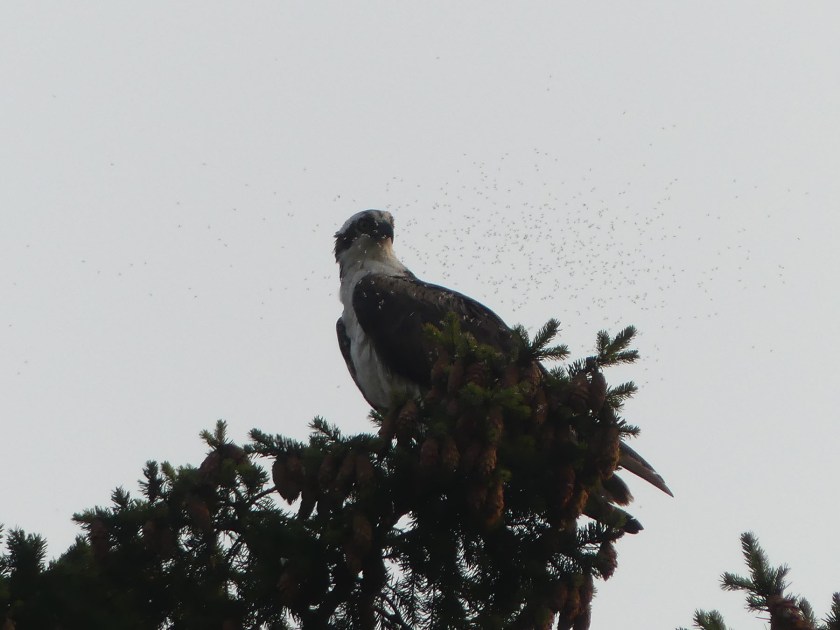
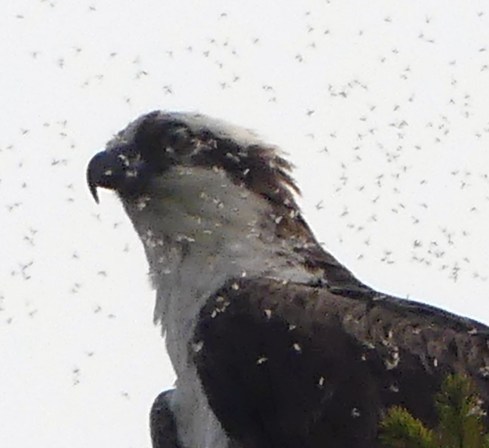
Osprey Under Attack
I’m determined to bird today so I carry on. As long as I don’t linger in any one spot, I seem to be okay. Speed doesn’t make for easy birding however. Nothing seems to want to stay put, like me. A noisy gaggle of young Waxwings zips through the higher branches, too skittish to pause for pictures. Likewise, a Bewick’s Wren appears and poses just as I turn my camera off to save the battery, and then ducks away as the machine blinks back to life. Towhees and Fox Sparrows are especially furtive. After forty minutes of fruitless searching, I’m almost done. I have just one more trail to try. It takes me under the trees and into deep shade, which is suicidal. Never mind. I hurry like I’m crossing No-Man’s Land to get to my home trench. I’m literally turning on my heel to make a run for it when I spot a young Great Horned Owl. Figures. Now I don’t care about mosquitoes — well, that’s a lie. Still, with such a beautiful bird and such beautiful light, sacrifices had to made. Now, where did I put that calamine!
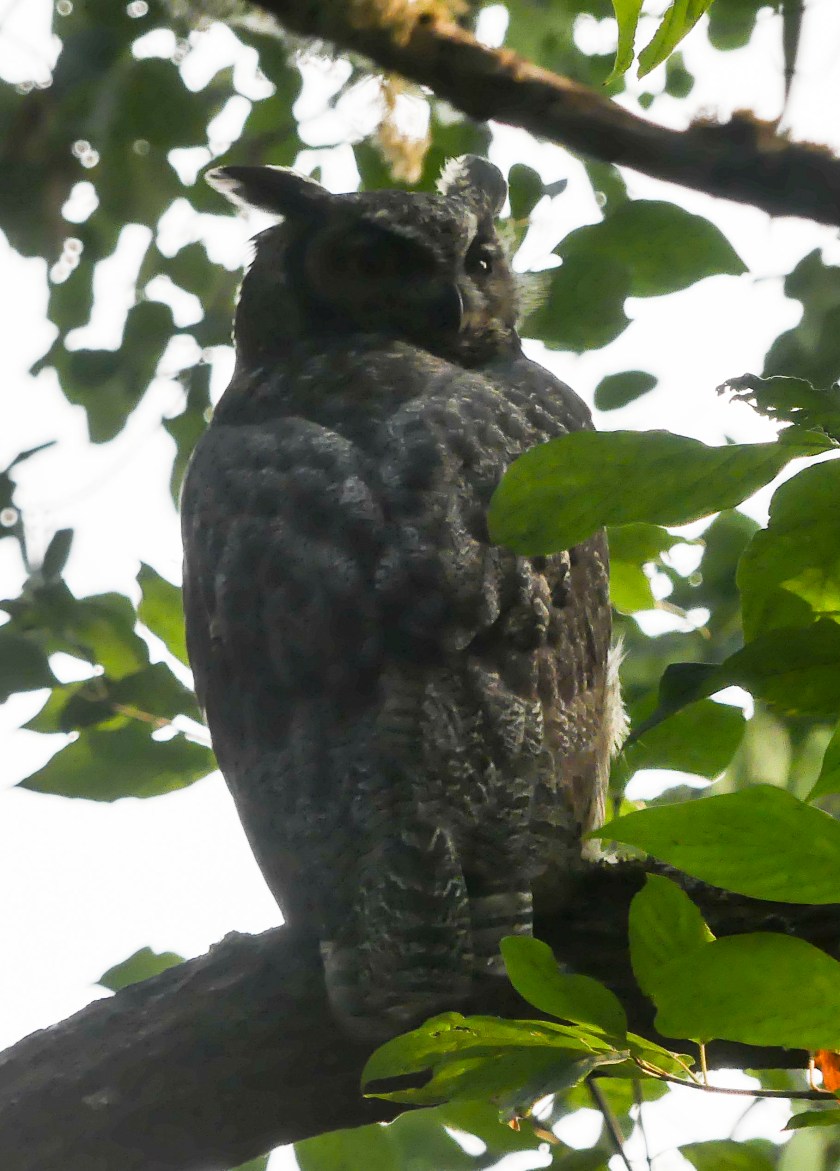

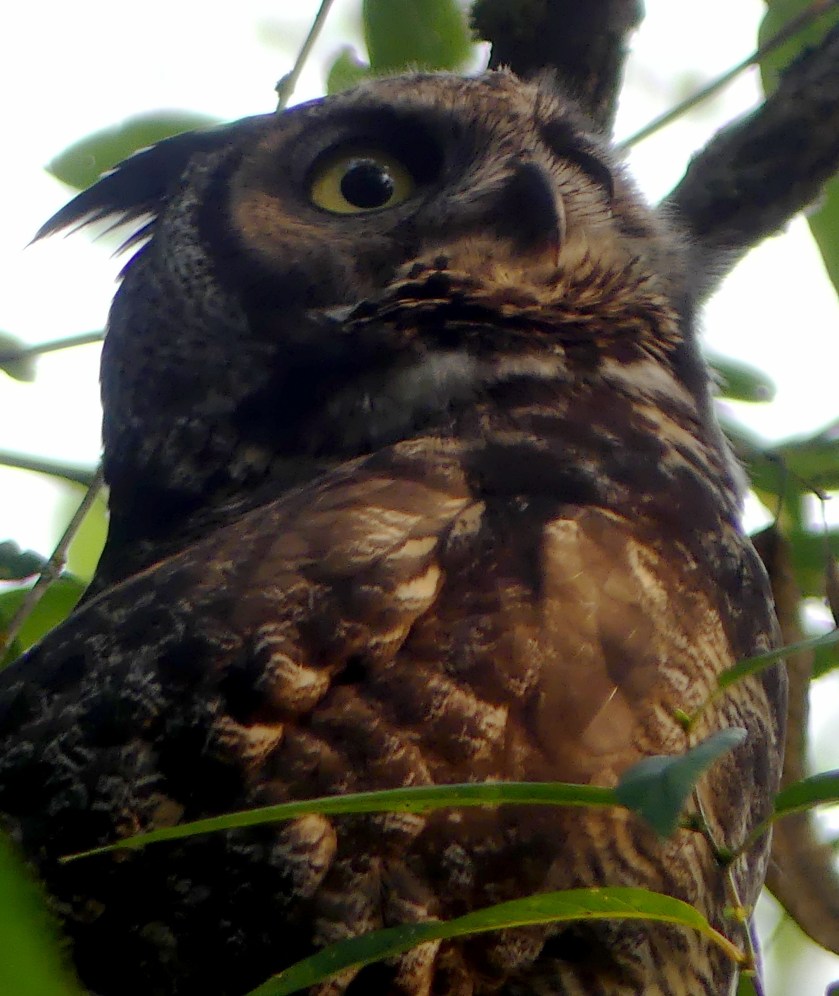
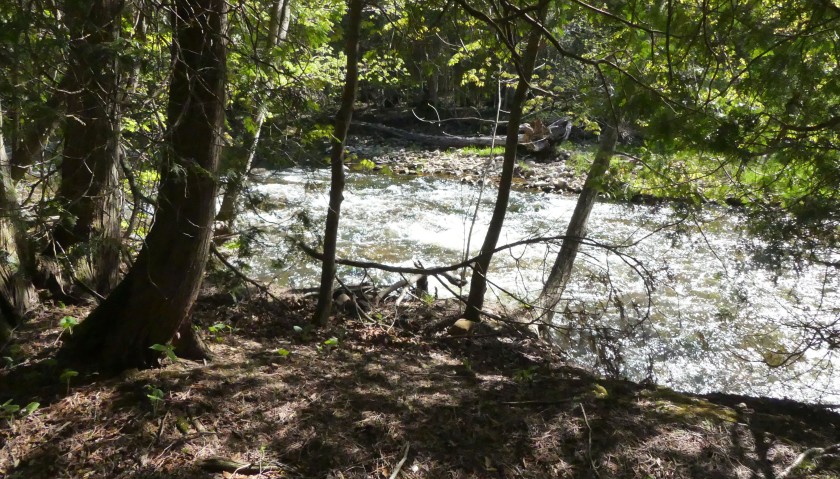
A Perfect Little River…
The woods around my hometown are beautiful in May. It’s a great time to walk up the Sydenham River towards Inglis Falls. I spent many boyhood hours on, or in, or near the Sydenham. In all seasons too. That hillside over there – the snow leaves it first. It’s a good place to cook a can of beans over a campfire and lie back to bask in the late winter sun. Dry, clean ground in a world of snow, the smell of wood smoke and caramelized beans. A memory. Around me the Trilliums and Dogtooth Violets are coming in nicely. And the greens – soft, warm, luminous and arrestingly pretty.
The burgeoning foliage has its downside for a birder. It’s much harder to spot the little guys. I trace a pert Ovenbird by its ‘teacher, teacher, teacher’ song. A line of bouncing leaves marks the passage of a Nashville Warbler intent on bug picking, ignoring a tail-flicking Redstart. Overhead a Baltimore Oriole flashes orange. Higher up above the ‘Mile Drive’ a couple of male Ruffed Grouse start to drum – the slow ‘whumpf — wumpf — wumpf’ quickly increasing in tempo and climaxing in a muffled and impressive super-grouse-sized roar.
I cut away to avoid a flooded section of path. My detour takes me past a memory – a patch of jumbled dolomite where long ago I stashed and later lost a canvas knapsack. A peripatetic porcupine, or several, ate it right down to the buckles. Nothing left but metal. In one night!
I lost a perfectly good cheese whiz and onion sandwich wrapped in wax paper to the prickly little guys too. Today I’d worry about the harm the white bread and canvas might do to the wildlife. I’m not sure I was feeling quite so equable at the time.
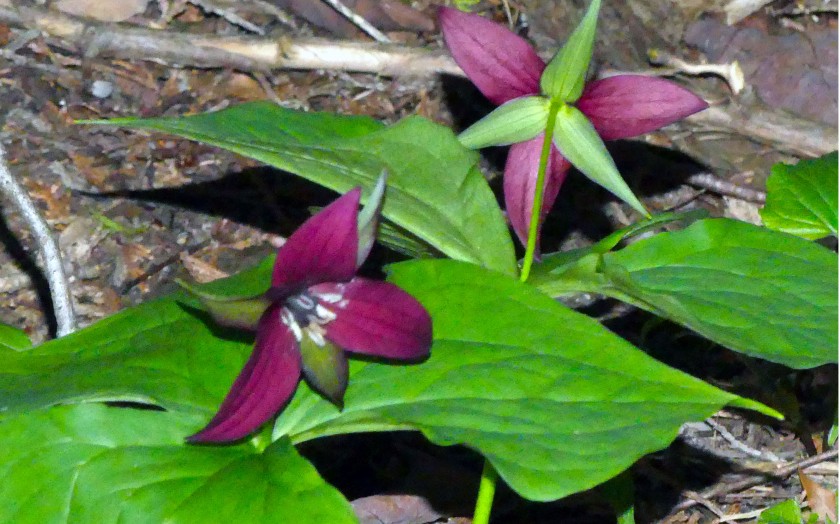
Red Trillium
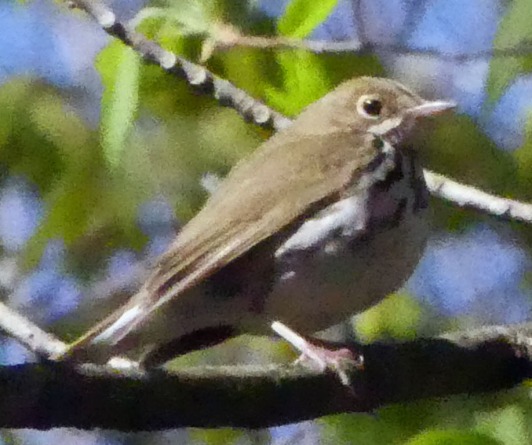
Ovenbird
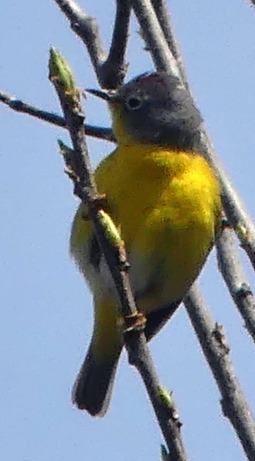
Nashville Warbler
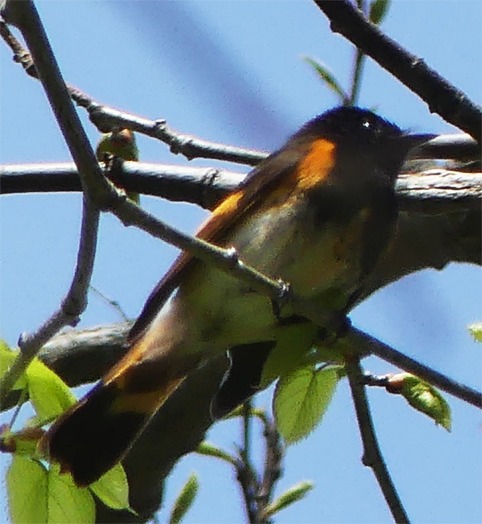
Redstart
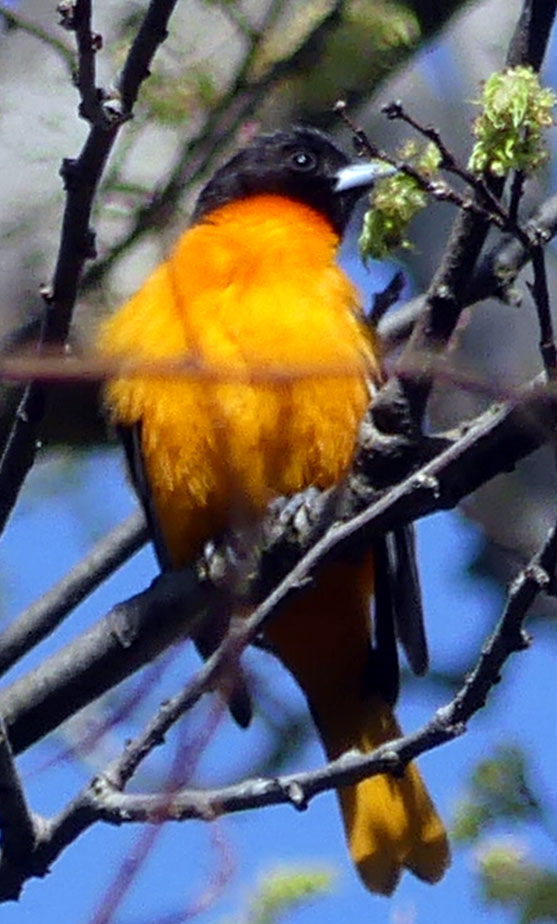
Baltimore Oriole
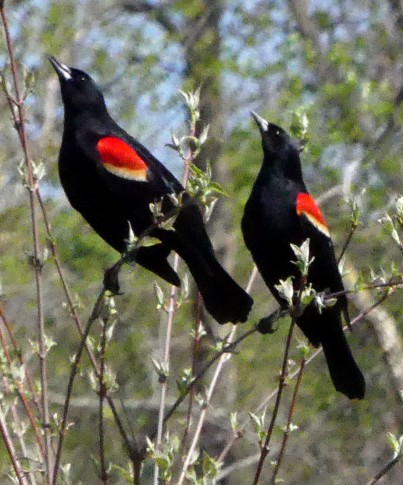
Redwing Blackbirds
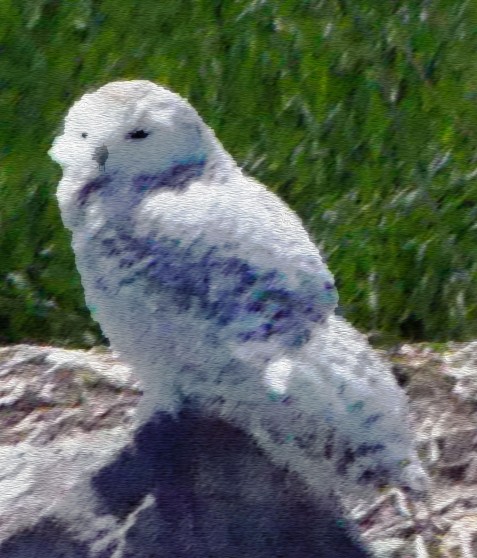
I leave the river and head for the country roads. As always I check the rare bird reports wherever I go. The latest surprises me – three or four Snowy Owls seen in Grey and Bruce counties. Right now? Amazing! It’s the last bird I expected to see. Likely I won’t, not with my bird luck. I take up the chase anyway. It’s a compulsion after all and not entirely rational. I spend quite a few hours searching the countryside. I pick up a few good birds – wild Turkeys, a lone Sandhill Crane, an equally lone Broad-winged Hawk. No Owl though. By this time, I’m famished and I’d really like to stop for a late lunch. One last road to try and then I’ll stop. Just when I’m about to turn back, there it is – calm as can be, sitting on a boulder at the edge of a swale that’s likely teaming with rodents. There’s no way I can get close enough for a good photo but I’m happy, thrilled actually.
After lunch, I head back to the sparkling Sydenham, likely for the last time this year. Family dinner tonight and a visit with one of my cousins. Tomorrow I’ll head south to Toronto and then the flight home. I’ll leave early just in case there’s a rare bird or two to ‘pick up’ on the way down. I’ve still got the bug.

Snowy Owl
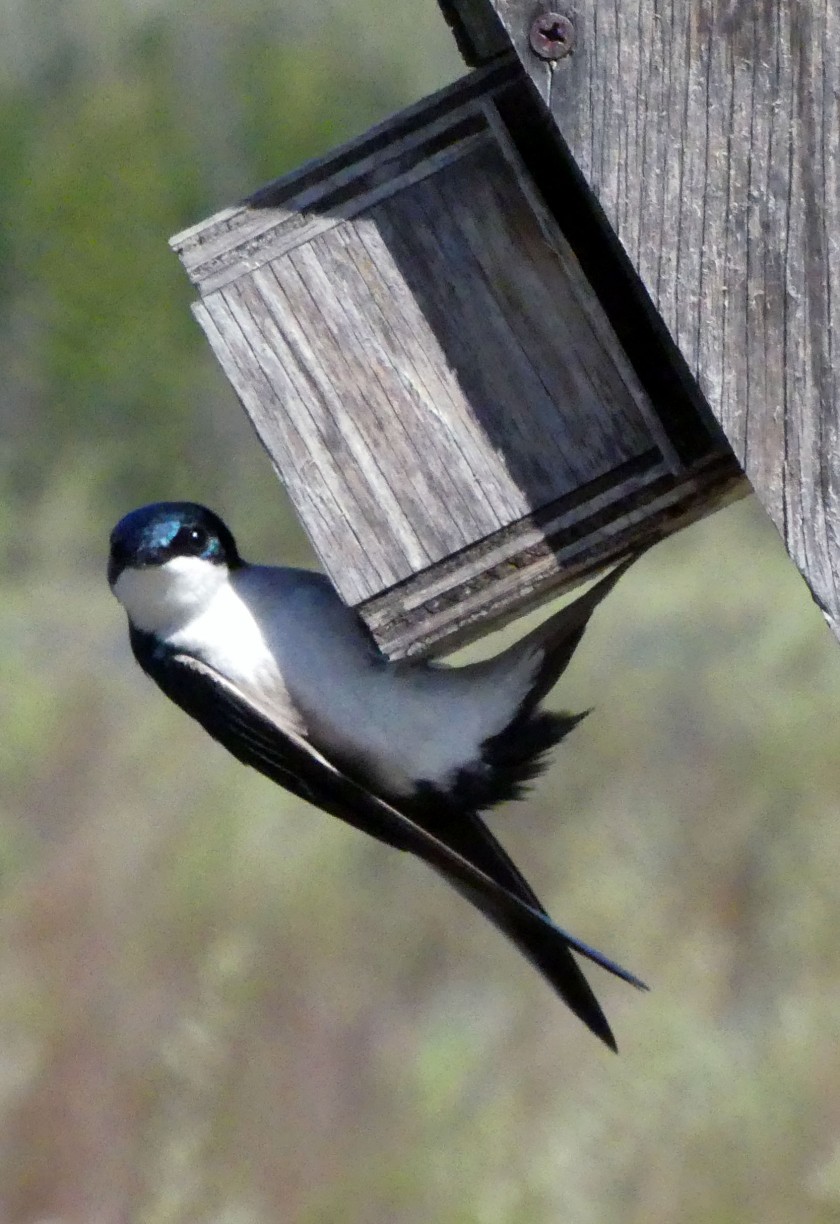
Tree Swallow
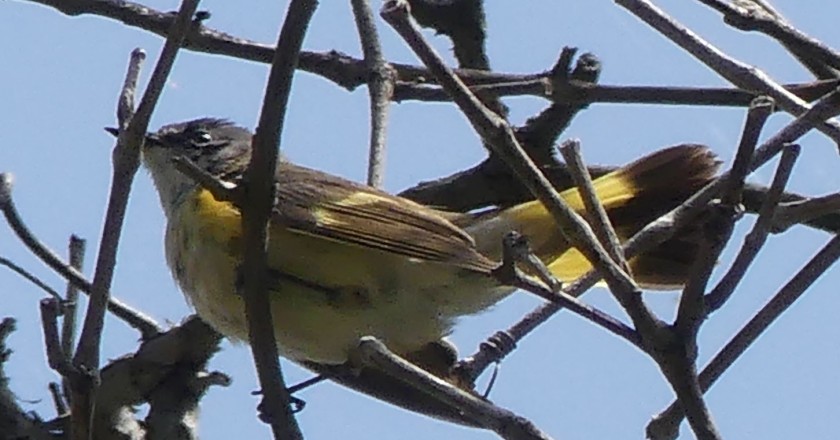
Redstart – Female
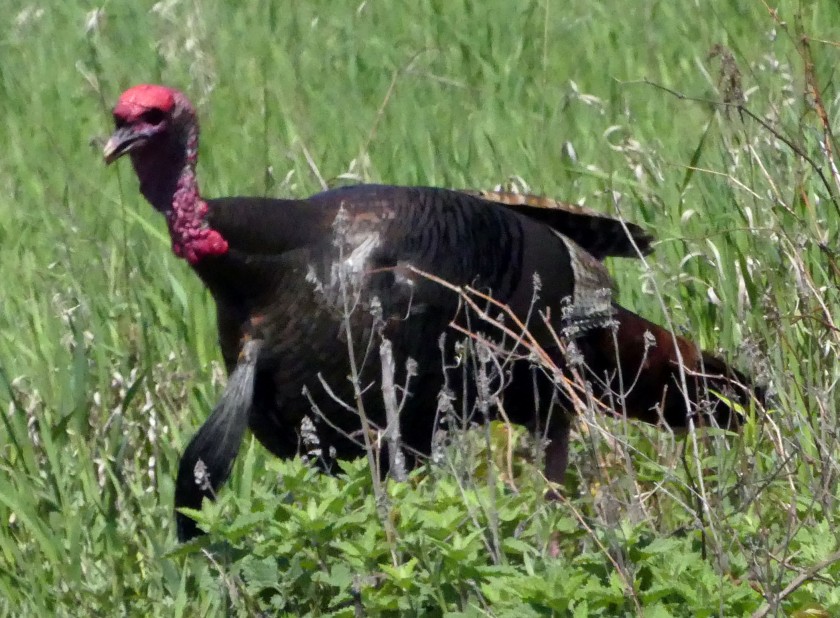
Wild Turkey
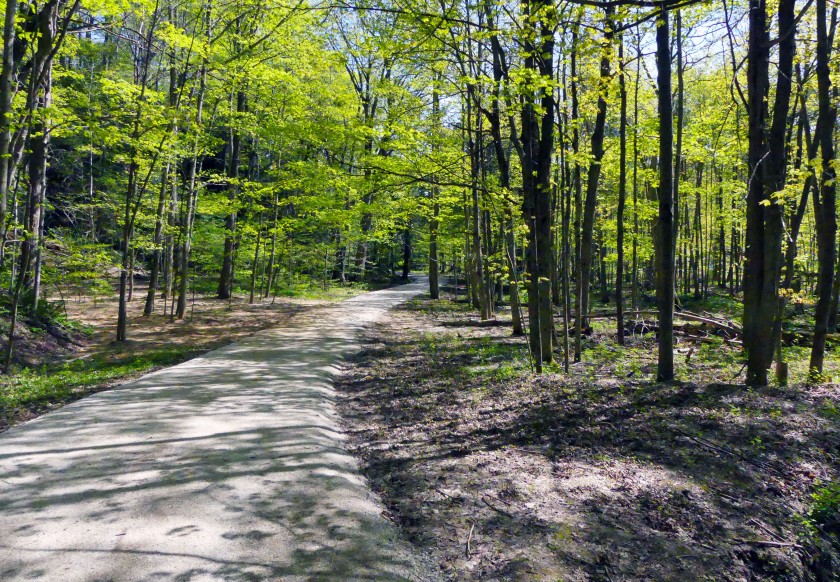
The Mile Drive
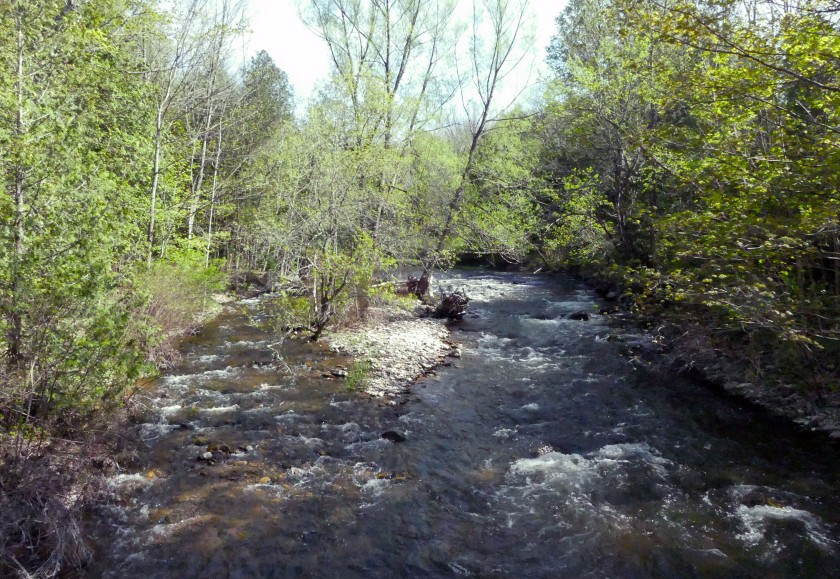
A River Runs Through It
I didn’t expect the Coatis. A troop has discovered the bird feeders at Santa Rita Lodge in Madera Canyon. Big ones, little ones. I’m here with my brother Steve, who flew down from Ontario for some Arizona birding. I know Coatimundis from my zoo days decades past. Mischievous, rubber-nosed, ring-tailed bandits, very engaging. Lots of personality. I still remember them lying on their backs, lapping eggs out of the shell, grunting at each other, recalling some caper or other. All those years ago. Seeing them again makes me wonder how ground-nesting birds manage to hatch out chicks at all. Is it possible to avoid the ever-searching, wiffling noses? Me, I think of them as old friends.

Coatimundi
Early morning and the viewing chairs are already taken. Popular spot this. One of the best feeding stations anywhere, maintained by the kind folks at Santa Rita Lodge, supported hopefully by donations that help buy the enormous amounts of feed needed to constantly replenish the feeders. The Coatis won’t be welcome here, not those appetites on four legs.

Pine Siskins
They don’t seem to bother these birds. A Rufous-crowned Sparrow in a tangle of dead wood. Rufous-winged Sparrows, Lesser Goldfinches, Siskins, Mexican Jays, Dark-eyed Juncos and a beautiful Yellow-eyed Junco work the feeders. A bright Hepatic Tanager puts in a brief appearance, its place on a half orange grabbed immediately by a clown-faced Acorn Woodpecker. An Arizona Woodpecker, a life bird for me, shows up. Lovely – with its chocolate-brown mantle. We hoped for a Painted Redstart on the trails but kept missing the bird everybody else seemed to see. A Red-naped Sapsucker posing photogenically eases our disappointment.
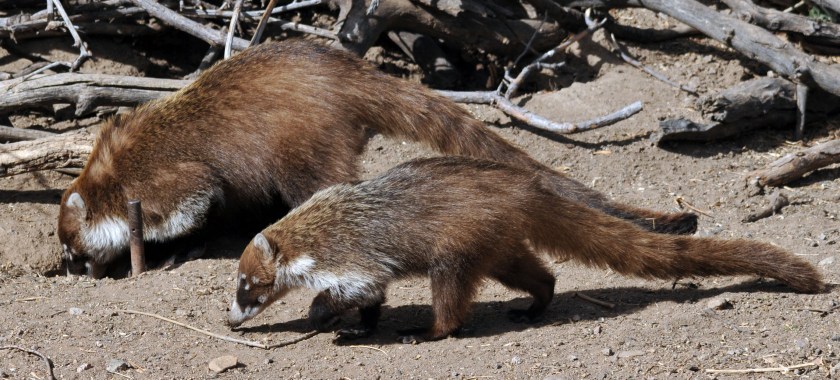
Coatimundis (Coatis) – Parent and Child
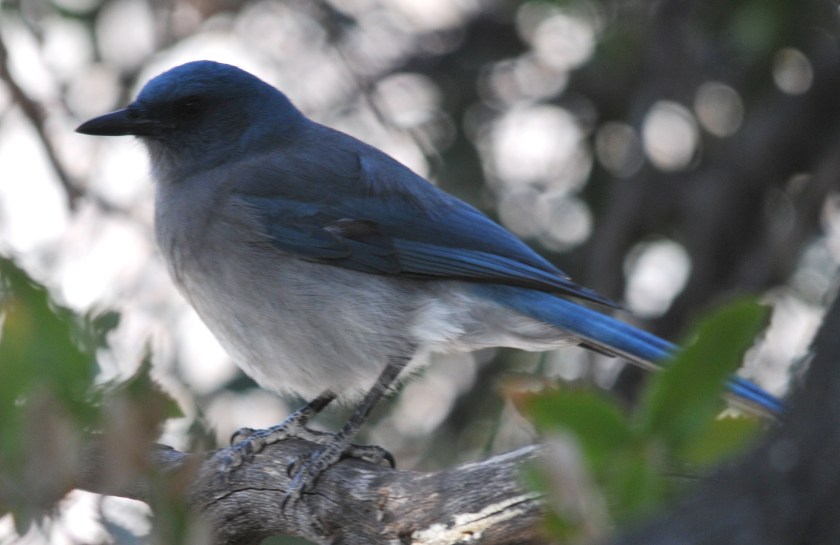
Mexican Jay
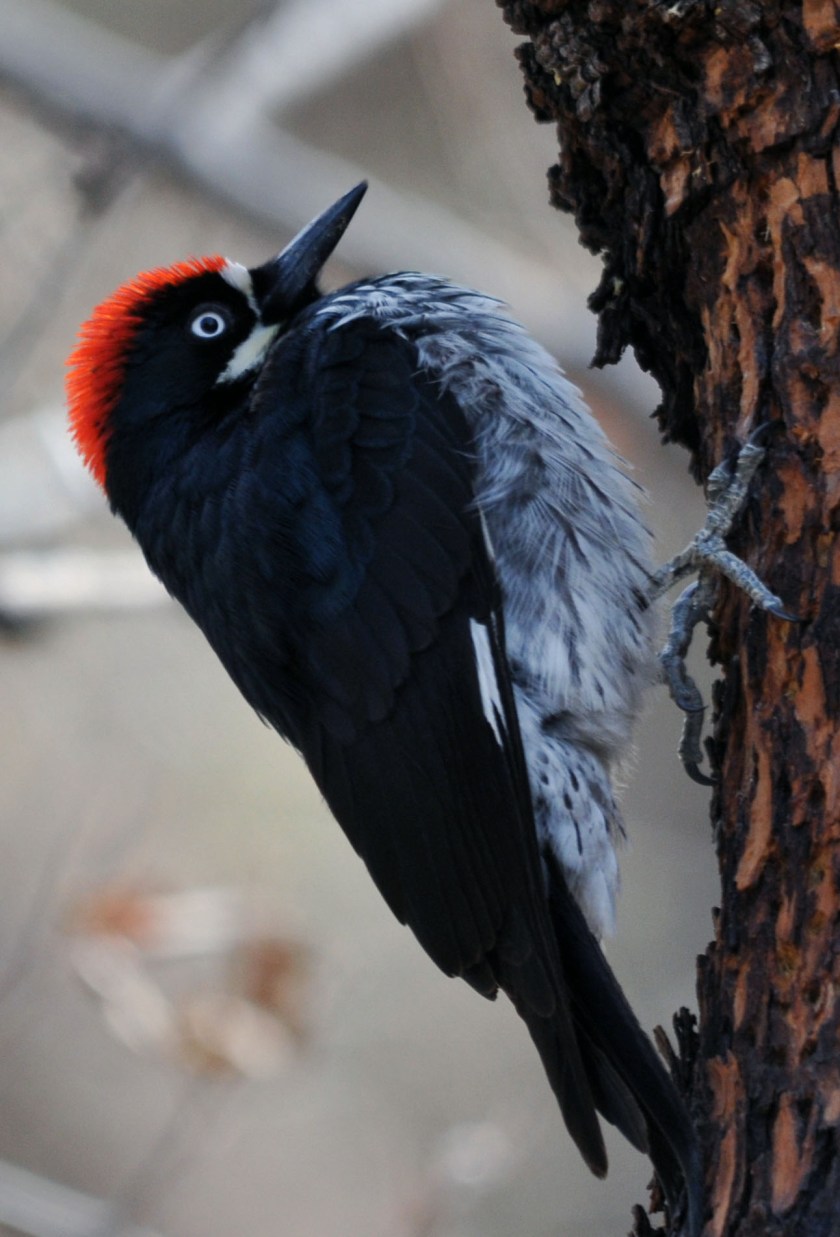
Acorn Woodpecker
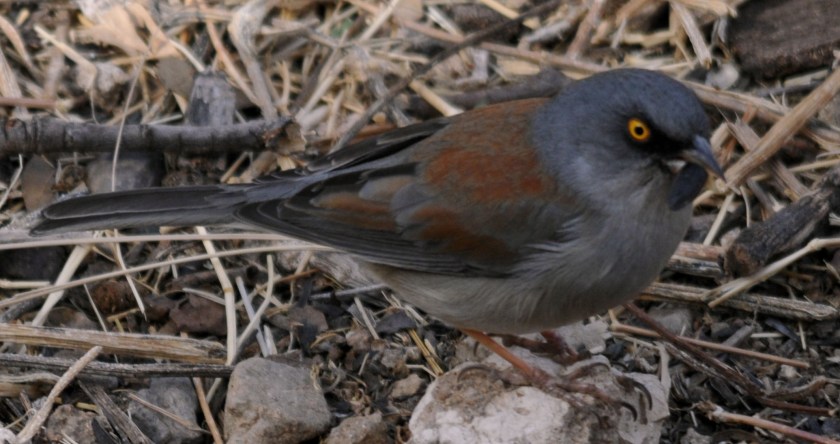
Yellow-eyed Junco
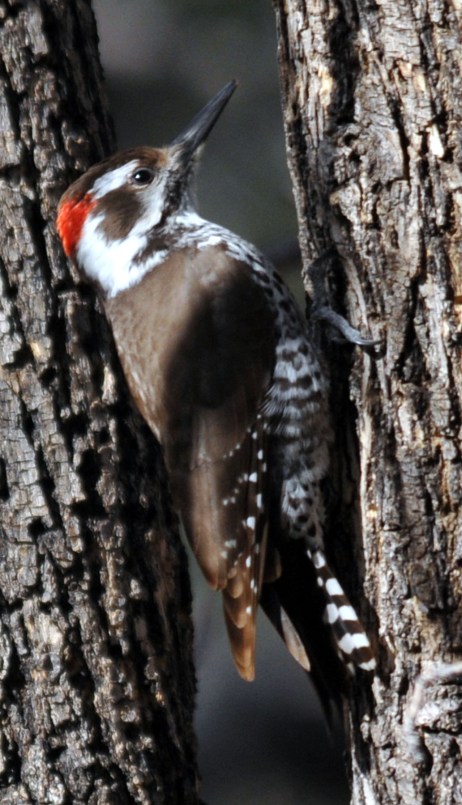
Arizona Woodpecker
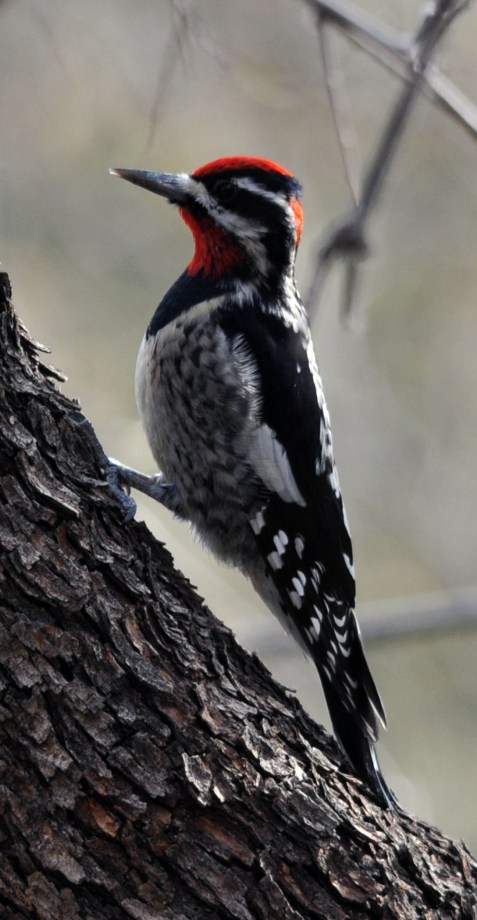
Red-naped Sapsucker
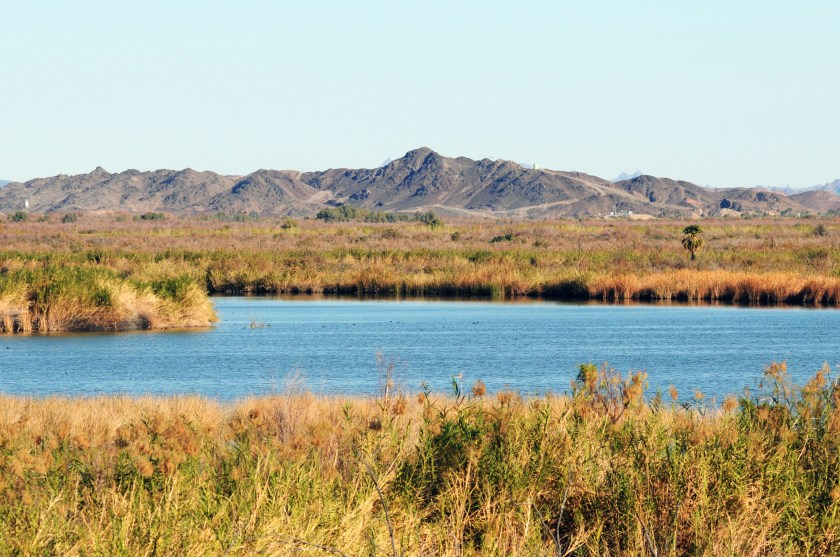
Mittry Lake
I need to head out from Yuma before daylight to have any chance of hearing a rare Black Rail at Mittry Lake. The lake is up in the hills and the tiny Rails stop calling before sunrise. I start of well enough but soon I’m in serious agricultural country and lost, dodging huge, road-straddling farm machines of indeterminate purpose, submerged in a sea of dust and stabbing headlights. It’s rather like rather being part of some lost footage from Close Encounters. My GPS is no help whatsoever by the way. I’m that boxy car icon on the flat green background in a land where no roads exist, including the one I’m presently on. When I finally escape and luck my way up to the opposite end of the Mittry Lake road (which was not my destination) the sun is high and my chances for the Black Rail are now nil. Luckily other birds live here, Ridgway’s Rail for one — a life bird for me. Ridgways used to be just plain old Clapper Rail but recently got split off into its own species. For birders and their lists, splitting species is great, lumping (two Warblers into one species, for example) not so much.
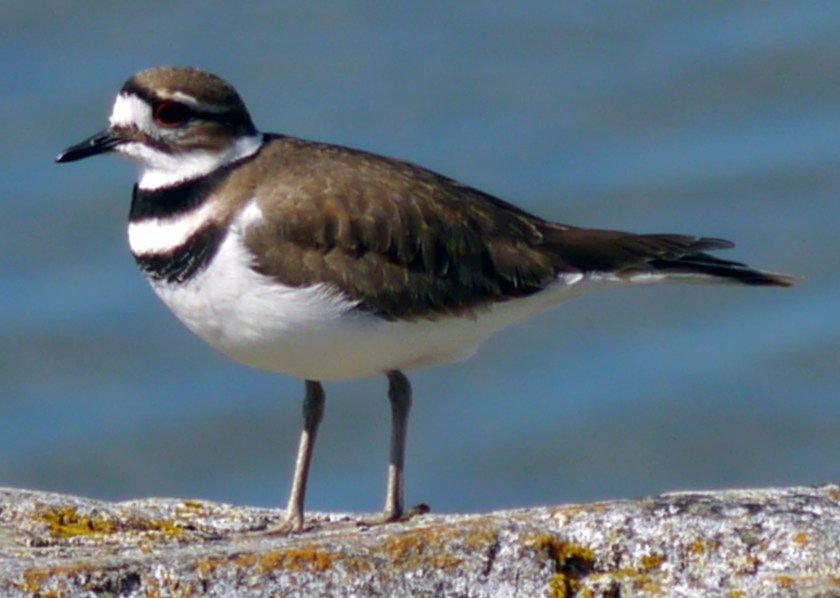
Killdeer
I’m not sure what I was expecting at Mittry but not this. Snowbird RVs occupy almost every access to the Lake, which kind of spoils the ambience for me, though it’s possible I’m just feeling cranky after the drive. Even Betty’s Kitchen, the protected wildlife area is not very ‘birdy’ right now — a Great Blue Heron, some Killdeer, one or two Anna’s Hummingbirds and a few squeaky Gila Woodpeckers. I see birds on the water — Ruddy Ducks, gorgeous Cinnamon Teal, Pied-billed, Eared, Clarke’s and Western Grebes but most too far away to photograph. The biggish white blobs I spot in the distance turn out to be Pelicans.
Cinnamon Teal

Anna’s Hummingbird
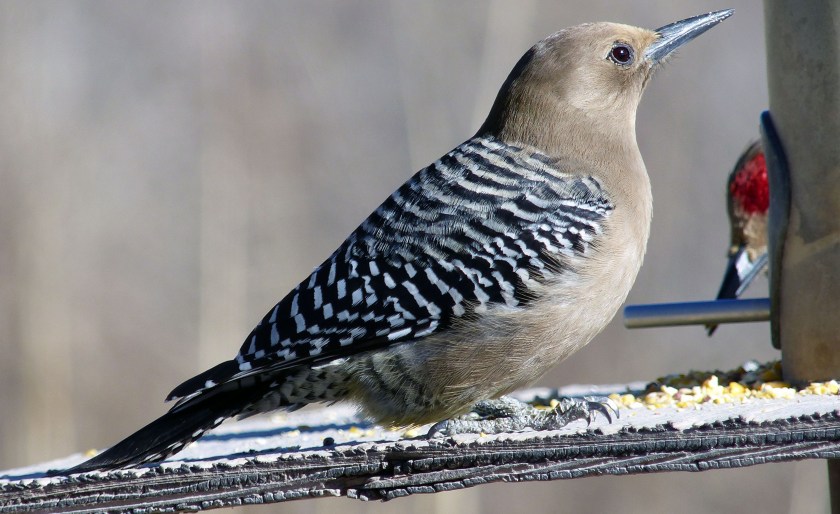
Gila Woodpecker
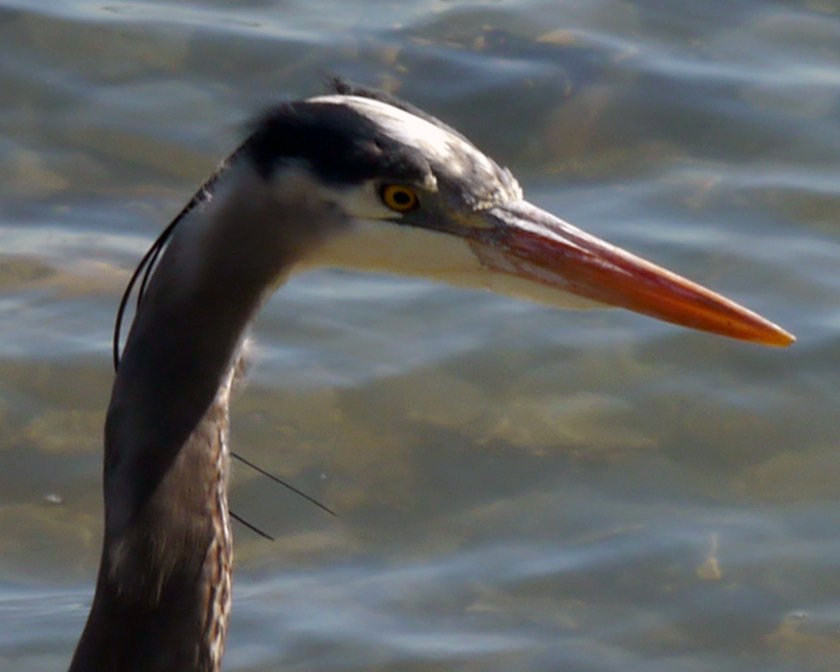
Great Blue Heron
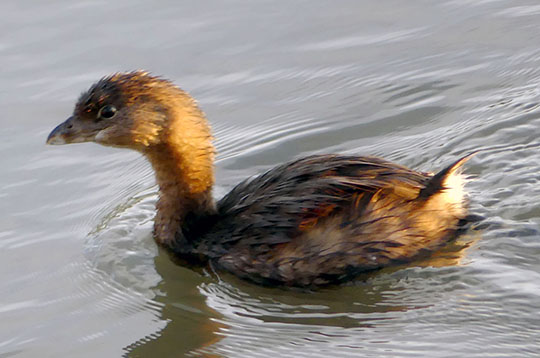
Pied-billed Grebe
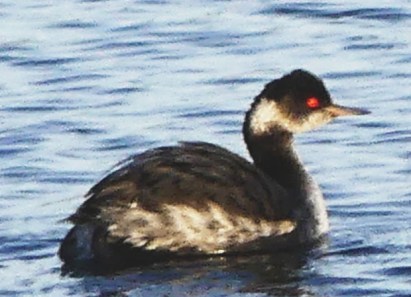
Eared Grebe
I drive along the shore stopping wherever I figure good rail habitat exists, those areas of dense rushes and cattails with just enough open water to allow me to spot the little guys should one decide to show itself. I’m stepping over a wet patch following a Gila Woodpecker when a Ridgways suddenly lets loose right at my feet, loud, like two rocks smacked against each other – clack, clack, clack, clack. Fast. I’m startled and almost fall backwards. Did I catch a fleeting glimpse of the bird? Maybe. Sometimes, I’m delusional. If I had got a photo, which I didn’t, it would have resembled a larger version of a Virginia Rail, like this one – sort of.
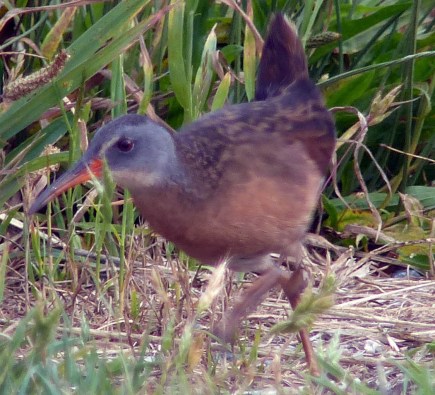
Virginia Rail
 Bird Noetz